
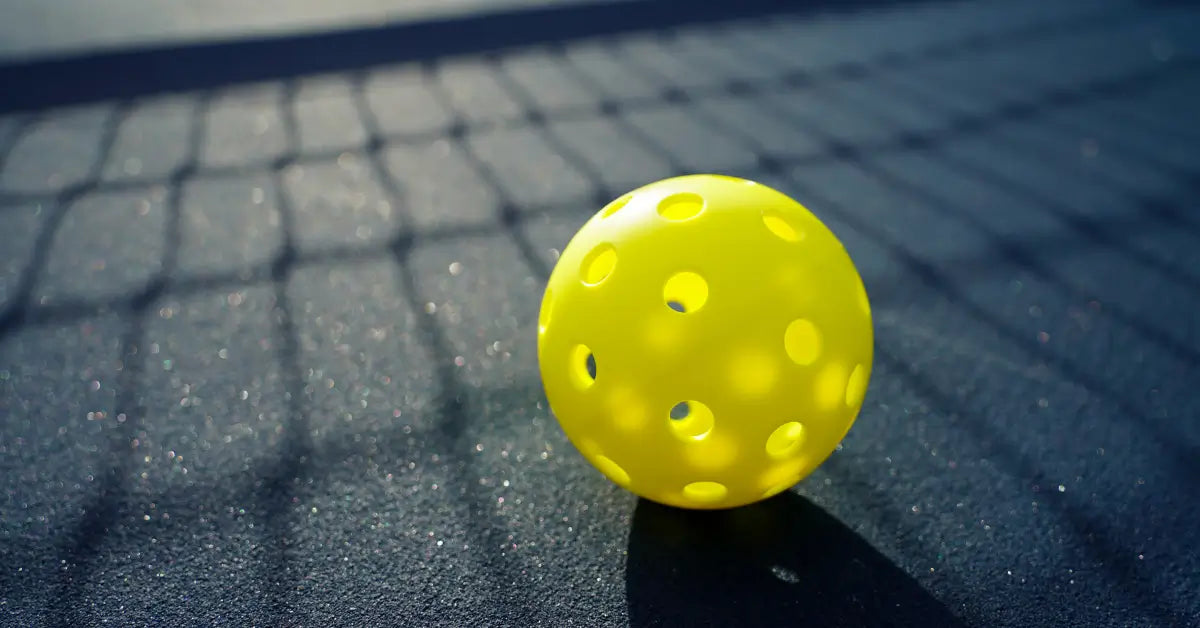
You open a fresh pickleball, tap it a few times off your paddle face, and it feels fast and lively. Two weeks later, something feels off — slower, a little dead — but it looks fine. No cracks, no obvious damage. So you keep playing with it.
That's the trap. Understanding how long do pickleballs last isn't just about watching for the crack that ends a ball's life — it's about recognizing the slow decline that starts well before then, and knowing what to do about it.

How long do pickleballs last?
Most sources quote the same window: outdoor pickleballs last 3 to 10 games, indoor balls a bit longer. That range isn't wrong, but it's not particularly useful either. A "game" for a competitive 4.0 player hammering drives and overhead smashes is very different from a recreational doubles session built mostly on dinks and slow resets.
Play intensity matters more than game count. A Franklin X-40 tested under competitive conditions by Pickleball Science showed measurable stiffness loss within 4 to 8 games — but that same ball, used in casual recreational play, lasted 20 or more sessions before cracking. Your pickleball lifespan depends almost entirely on how hard you're hitting it, not just how many times you've used it.
What actually kills a pickleball faster than you think
The two main enemies of a pickleball aren't your swing speed or even the court surface — they're heat and cold, and most players are creating both problems in their gym bag.
Three specific conditions accelerate ball wear beyond anything you do on the court:
- Extreme heat (think: car trunk in summer). Polypropylene plastic softens under sustained heat, permanently deforming the ball's round shape. A ball that spent a week in a hot trunk before you even play with it is already compromised.
- Cold-weather brittleness. Balls used in temperatures under 50°F crack far more easily. The plastic contracts, loses flexibility, and can't absorb impact the way it was designed to. Outdoor players in northern states during fall and winter eat through balls at double the normal rate — this isn't bad technique, it's physics.
- Rough asphalt courts. The abrasive surface slowly erodes the ball's outer layer with every bounce. Concrete is better; smooth sport court is better still. If your home court is old cracked asphalt, expect your balls to do pickleball ball wear at an accelerated rate regardless of how careful you are.
Outdoor balls vs. indoor balls — the lifespan gap is bigger than most players expect
Outdoor pickleballs are harder, heavier, and made from a thicker polypropylene to handle wind and rough surfaces. That hardness is a performance feature — but it also makes them more brittle under repeated hard impact. They crack. That's their failure mode.
Indoor pickleballs are softer and lighter, with larger holes sized for gym-floor conditions where wind isn't a factor. They don't crack the same way outdoors do. Instead, they slowly go soft and lose their bounce — a quieter death, but just as real. They do tend to last slightly longer in terms of game count, often 10 to 15 sessions for a recreational player before the bounce becomes noticeably inconsistent.
Using a USAPA approved outdoor ball on an indoor court won't ruin it immediately, but you're spending money on durability you don't need indoors. And taking an indoor ball outside grinds it down in a session or two. Match the ball to the surface, and both types last meaningfully longer.
Five signs your pickleball is done — and one quick field test
The soft-spot squeeze test most players skip
Hold the ball in one hand and press your thumb firmly against it, working your way around the surface. A fresh ball resists evenly. A worn ball has soft spots — small areas that yield more than the rest. You'll feel it before you can see it. Once a soft spot appears, ball stiffness has dropped enough to affect the bounce, and performance won't come back.
Beyond the squeeze test, watch for these five signs that your ball's done:
- Visible cracks. Any crack, no matter how small, means the ball is finished. Mid-rally cracks are disorienting and can cause wrist strain from the sudden shift in impact feel.
- Inconsistent bounce. Drop the ball from shoulder height. It should bounce uniformly every time. Two bounces that vary by more than a couple inches signal the ball is no longer round.
- Loss of "pop." The sharp sound a fresh ball makes off the paddle face goes dull. If it sounds different — flatter, quieter — trust that instinct.
- A wobble in the air. Spin the ball gently in the air by flicking it off your palm. A ball that's gone out of round wobbles visibly. You'll see it immediately.
- Shots going where they shouldn't. This one is easy to misattribute to your own technique. Before blaming your drop shot, check your ball. A worn ball flies inconsistently regardless of how clean your swing is.
How to actually get more games out of every ball
Storage is where most players lose ball lifespan before the first point is even played. Keep balls indoors, at room temperature, away from direct sunlight. Don't leave them in your car overnight — not in summer heat and not in winter cold.
Rotating between three or four balls during practice sessions distributes wear across the set instead of burning through one ball at a time. It sounds minor, but players who rotate report noticeably longer use from every ball in their bag.
Cleaning helps, too — more than people expect. A damp cloth after an outdoor session removes the court grit that abrades the surface during every subsequent bounce. The same discipline that goes into cleaning your paddle after every session pays off with balls. It takes fifteen seconds.
Finally, if you're playing on a rough outdoor surface, consider keeping a separate set of balls for that court. Don't use your good competition balls on broken asphalt and then wonder why they cracked in three sessions.
What it actually costs to replace pickleballs for a year
Here's the math nobody runs. A recreational player who plays twice a week with three balls in rotation, using outdoor balls on a decent surface, goes through roughly 12 to 20 balls per year — somewhere between $36 and $80 annually. That's less than one dinner out. For that amount, you could keep a supply of fresh, consistent balls on hand all year instead of grinding a worn set down to nothing.
The cost math changes fast at the competitive end — serious club players hitting four or five sessions per week can burn through the same number of balls in two months — but for most players reading this, the answer is the same: replace early and replace often. Playing on a dead ball doesn't save money; it makes you feel worse on the court than you actually are, and it costs you nothing to fix.
When you're ready to stock up, pickleballs built for consistent bounce — especially ones rated for your court type — will deliver a noticeably better game than running worn ones into the ground.
The real answer to how long do pickleballs last? Long enough that you'll probably run them longer than you should. Don't. The cost of a fresh ball is trivial. The cost of blaming your game on a ball you should have swapped out two weeks ago is harder to calculate.
FAQs
Why do pickleballs crack so fast?
Outdoor pickleballs are made from a hard polypropylene that handles wind and rough courts well but becomes brittle under repeated impact — especially in cold temperatures. Heat from car storage accelerates this by warping the plastic before you ever play with it.
How do you know when a pickleball is dead?
Press your thumb around the ball's surface feeling for soft spots; any area that yields more than the rest means the stiffness is gone. An inconsistent bounce when dropped from shoulder height confirms it.
Can you use a cracked pickleball?
A cracked ball is unpredictable — it bounces erratically and can create an uneven strain on your wrist at impact. Retire it immediately; cracked balls don't get better with more play.
Do pickleballs expire if not used?
Stored balls don't expire quickly, but heat cycles — particularly leaving them in a car over weeks or months — can warp the plastic and compromise bounce before you even open the bag.
How many pickleballs should I own?
Three to four balls per session is a practical minimum; it lets you rotate usage evenly and ensures you always have a backup if one cracks mid-game.
Does cold weather ruin pickleballs?
Playing in temperatures below 50°F makes the plastic brittle enough that normal shots can crack a ball that would survive the same hit on a warm day — stick to indoor balls when it's cold, or accept faster outdoor ball turnover.


