
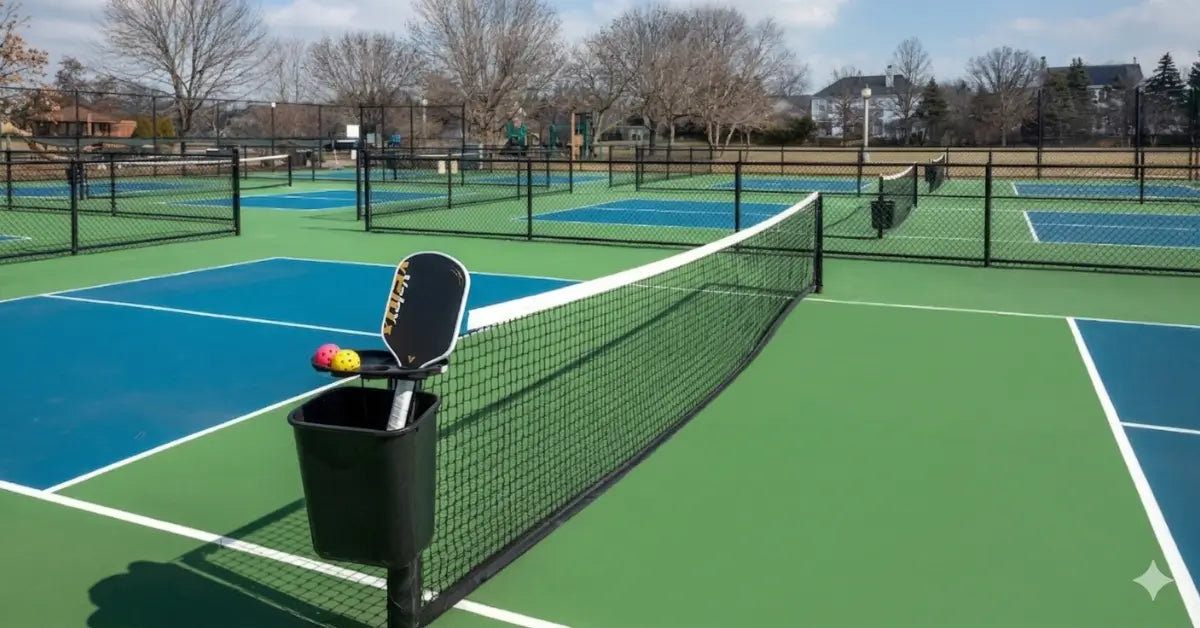
Most people who start playing pickleball spend their first few sessions just figuring out where to stand. Then, one day, someone calls a kitchen fault on them — and they realize they never actually learned the measurements. The court looked small. They assumed they understood it. They didn't.
This guide covers every official pickleball court dimension, from the baseline to the net post, including the numbers most players never bother to look up until something goes wrong.

The Playing Surface: 20 × 44 Feet, and Why That Size Is Exactly Right
A regulation pickleball court measures 20 feet wide and 44 feet long. That's the same footprint as a standard doubles badminton court — not a coincidence. Pickleball was invented on a badminton court in 1965, and the original dimensions stuck because they worked.
The total playing area comes to 880 square feet. That's less than one-third the size of a tennis court, and it's a big reason the sport is so accessible. Shorter sprints, faster rallies, less real estate to cover. It also means two players can dominate an entire court from the kitchen line — positional play matters far more here than raw speed.
One thing that surprises a lot of new players: pickleball court dimensions are identical for singles and doubles. No wider alley, no modified boundaries. Singles players cover the same 20 feet of width as a doubles pair, which is why singles strategy looks so different — it's more ground to protect with half the people.
The Kitchen: That 7-Foot Zone That Controls the Entire Game
The kitchen — officially the Non-Volley Zone (NVZ) — extends 7 feet from the net on each side and spans the full 20-foot width of the court. That's 14 feet of combined depth, and it's the single measurement that defines how pickleball is played.
Why 7 feet? Stand at the kitchen line and you'll understand immediately. You're close enough to the net to threaten with short angles, but far enough back that volleying straight down is nearly impossible. That distance forces finesse. It's what makes dinking the dominant skill at every level above beginner.
The Momentum Rule Nobody Warns You About
The kitchen fault isn't just about your feet being inside the zone at contact. If you volley the ball and your momentum carries you across the kitchen line afterward, it's still a fault. You can't jump, hit a volley, and land inside the zone. The rule applies to your entire body — and it extends to anything you're holding or wearing. Drop your paddle in the kitchen after a volley? Fault.
To understand the full ruleset governing play inside this zone, the rules that govern what you can and can't do inside that zone are worth reading in detail before your first competitive game.
The One Serve Exception
The kitchen line is also the only court line that counts as out for a serve. Every other line on the court — sidelines, baselines, centerline — is considered in. But a serve that clips the NVZ line is a fault. This matters because serves must clear that 7-foot zone completely and land in the diagonal service box.
Service Boxes, the Centerline, and Where Your Feet Actually Need to Be
Behind each kitchen, the court splits in half. The centerline runs from the NVZ line straight back to the baseline, dividing each side into a left service box and a right service box. Here are all the key measurements in one place:
- Baseline: runs parallel to the net at each end; 20 feet wide
- Sidelines: run the full 44-foot length of the court
- Centerline: runs 15 feet from kitchen line to baseline on each side
- Each service box: 10 feet wide × 15 feet deep
- All lines: 2 inches wide, counted as part of the court (in-bounds)
- Diagonal corner-to-corner distance: 48 feet, 4 inches
That last measurement is your squareness check. If you're laying out a court yourself, measure diagonally between opposite corners. If it reads 48'4" on both diagonals, your layout is square. If they don't match, something's off before you paint a single line.
Serves must be hit from behind the baseline, cross-court into the opponent's service box on the far diagonal. Your serve must clear the kitchen entirely — landing on the NVZ line is a fault even if it's technically a line.
Net Height: 36 Inches on the Sides, 34 in the Middle
The pickleball net stands 36 inches high at the posts — which sit 22 feet apart, one foot outside each sideline on both sides — and dips to 34 inches at the center. That 2-inch drop isn't cosmetic. It creates a noticeably lower target zone in the middle of the court, and good players exploit it deliberately: cross-court dinks and down-the-middle drives have about a half-inch more clearance than shots aimed at the sideline posts.
For reference, a tennis net is 42 inches at the posts and 36 inches at center. Pickleball's net is lower everywhere. The center dip is deeper proportionally, which is part of why the soft middle game — dinks, resets, third-shot drops — dominates at the kitchen.
One detail worth knowing if you're setting up a portable net: the net must extend at least one foot beyond each sideline on both sides. A ball that hits the net post extension and lands in bounds is still live. Most players don't know this until it happens.
How Much Total Space You Actually Need (It's More Than 20 × 44)
The playing lines measure 20 × 44 feet. But you can't build a 20 × 44 slab and call it a court. Players need room to move beyond the baseline when tracking a lob, and you need safe clearance so nobody runs into a fence mid-point.
USA Pickleball's official recommendation:
- Minimum total footprint: 30 feet wide × 60 feet long (1,800 sq ft)
- Preferred total footprint: 34 feet wide × 64 feet long (2,176 sq ft)
That means a minimum of 5 feet of clearance on each side and 8 feet on each end beyond the court lines. The preferred dimensions give you 7 feet on the sides and 10 feet on each end — enough room to chase down a deep lob without hitting the fence at full speed.
If you're planning a backyard court and can only carve out 30 × 60, it works. Go below that, and the margins feel uncomfortably tight after a few rallies. Most players who've played both say the 30 × 60 is livable; anyone who builds to 65 × 36 feet never wishes they'd gone smaller.
Converting a Tennis Court to Pickleball: The Layout Math
A standard doubles tennis court is 36 feet wide and 78 feet long. A pickleball court is 20 × 44. The math is favorable: one tennis court can fit four pickleball courts using the minimum 30 × 60 footprint per court, or three if you want the full preferred clearance.
The two most common conversion layouts:
- Two courts side by side: Use the existing tennis net line as a shared divider. Lower the net to 34 inches at center, mark the sidelines and kitchen lines on each side. Fast, cost-effective, reversible.
- Four courts in a grid: Requires portable or permanent net posts in the center of the tennis court, plus full re-striping. More courts, more complexity.
Line Color Strategy
When painting pickleball lines over an existing tennis surface, use a strongly contrasting color. Tennis lines are usually white; pickleball lines in yellow or green prevent confusion during play. Players need to read kitchen lines in under a second during a fast exchange — visual clarity isn't optional.
Indoor vs Outdoor Courts: Same Lines, Different Variables
The official pickleball court dimensions are the same indoors and outdoors. What changes is everything around the lines.
Outdoor courts are typically built on asphalt or concrete with an acrylic finish. That surface affects ball bounce, traction, and wear on your knees. Outdoor balls are slightly heavier with smaller holes to resist wind drift. If you're playing outside for the first time after months of gym play, expect the bounce to feel livelier and the ball to respond differently off your paddle face.
Indoor courts often share gym floors with basketball or volleyball. Ceiling height matters — a ceiling at 18 feet can turn a high lob into an odd bounce off the rafters. Some gyms use portable nets that sit slightly off true center height; always check net tension before the first game if you care about consistency. These aren't excuses. They're variables to account for and adapt to.
Setting Up Your Own Court: The Measurement Mistake That Trips Up Everyone
Here's the one error that catches nearly every first-time court builder: all court dimensions are measured to the outside edge of the lines, not the inside. Every line is 2 inches wide and is included in the court boundaries.
If you measure 20 feet to the inside edge of your sideline, your court ends up 4 inches too narrow. Do the same on the length and you're 4 inches short there too. Over 44 feet, that difference affects where serves land and whether close baseline shots are in or out.
Measure to the outside. Mark with chalk first. Check the diagonal (48'4"). Then paint.
If you're setting up a court to actually improve your game, having the right paddle makes the process feel worthwhile from the first session. The Velox Pickleball Paddle Set of 2 is a solid choice for players at this stage — the composite surface and balanced weight give you enough control to work the kitchen without fighting the equipment.
Conclusion
Pickleball's court is compact by design, and every measurement in it is deliberate. The 7-foot kitchen forces patience and precision. The 34-inch center net rewards cross-court angles. The 20-foot width is exactly wide enough to make positioning matter without turning singles into a marathon.
If you're playing on a public court, you're already on a regulation surface — trust the lines and focus on learning how to use the space. If you're setting up your own, measure to the outside edges, check your diagonals, and give yourself the full 30 × 60 feet if you can. The extra buffer changes how the game feels more than you'd expect.
Understanding the dimensions doesn't just help you build a better court — it helps you understand why certain shots work and others don't.
FAQs
What are the official pickleball court dimensions?
A regulation court measures 20 feet wide by 44 feet long for both singles and doubles play, with a total playing area of 880 square feet.
Is the pickleball court the same size for singles and doubles?
Singles and doubles use identical court dimensions — 20 feet wide by 44 feet long — with no additional alley added for doubles, unlike tennis.
How high is a pickleball net?
The net stands 36 inches at the posts and dips to 34 inches at the center; that 2-inch drop creates a meaningfully lower target zone in the middle of the court.
How many pickleball courts fit on a tennis court?
One standard doubles tennis court (36' × 78') can fit four pickleball courts using the minimum 30 × 60 footprint, or three courts if you want full preferred clearance margins.
What is the kitchen in pickleball?
The kitchen is the Non-Volley Zone — a 7-foot-deep area on each side of the net where players cannot hit the ball out of the air; it runs the full 20-foot width of the court.
How much total space do I need to build a pickleball court?
USA Pickleball recommends a minimum footprint of 30 × 60 feet and a preferred footprint of 34 × 64 feet to allow adequate run-off around the 20 × 44 playing area.


