
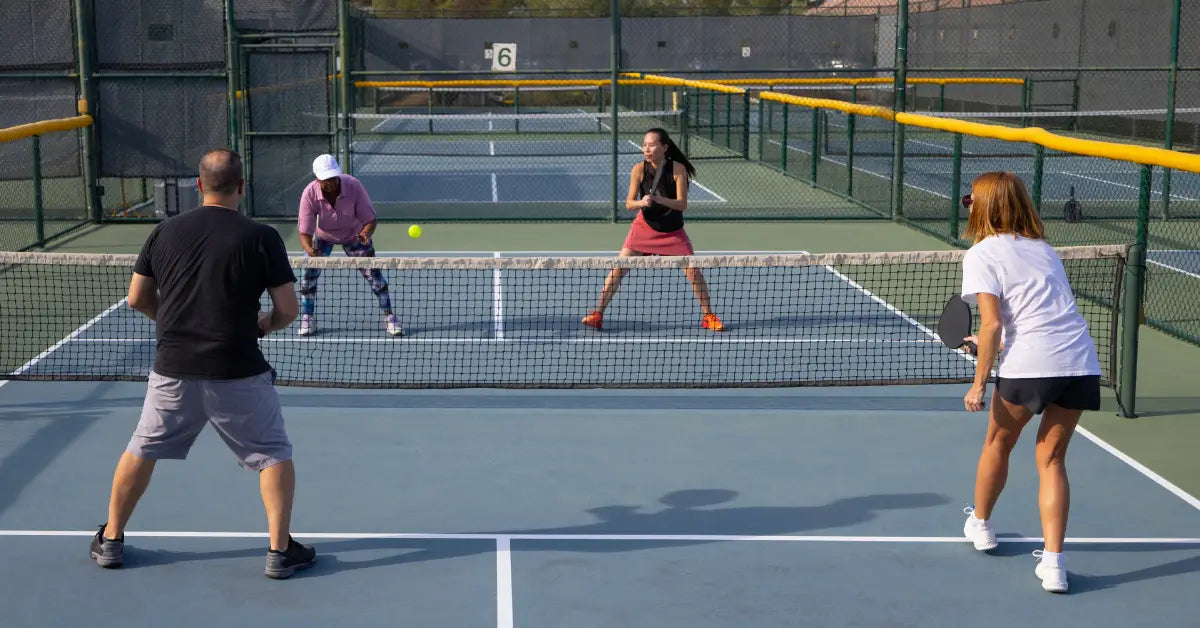
You've played a few doubles games, you understand the basic flow, and someone mentions singles. You think: how different can it be? Same court, same paddle, same ball.
It's different in ways that surprise almost every player who tries it for the first time — and not just because it's harder on your legs. Pickleball singles vs doubles involves genuinely different rules, completely different tactics, and a mental game that barely overlaps. Understanding those gaps doesn't just make you a smarter player in one format. It makes you better at both.

The Core Rule Differences That Catch New Players Off Guard
Most of the rules in pickleball apply equally to singles and doubles — the kitchen, the two-bounce rule, the underhand serve, scoring only on your serve. The differences are fewer than you'd expect, but they trip people up constantly.
Serving Side and Score Position in Singles
In singles, your position on the court tells you everything about the score. Serve from the right side when your score is even; serve from the left when it's odd. Win the rally and you keep the serve, switching sides each time. Lose it and your opponent serves. That's the whole system — two numbers, no server number, no partner to track.
If you're on the wrong side when you serve, that's a fault. New singles players call this out constantly in the first few games. The fix is simple: before every serve, say your score out loud. Even. Right side. Odd. Left side.
The Second-Server Rule in Doubles (0-0-2 Explained)
Doubles scoring adds a third number: the server number. "4-2-1" means the serving team has 4 points, the receiving team has 2, and the first server is currently serving. When that player loses the rally, the second server takes over — "4-2-2" — before the serve passes to the other team.
The only exception is the very first rally of the game. To prevent the serving team from having a built-in advantage, only one player serves to start, called out as "0-0-2." It signals that this team is already on their second server, so the serve will switch quickly if they lose.
Players who want a deeper look at pickleball scoring rules across both formats will find the full breakdown useful before their next match.
What the Court Actually Feels Like When You're Alone on It
The court dimensions don't change between singles and doubles — 20 feet wide, 44 feet long. What changes is that you're covering every inch of it by yourself.
In doubles, you and your partner divide the court roughly in half, switching and shifting together as play moves. In singles, there's no dividing. A sharp crosscourt shot forces you to run wide. A drop into the kitchen pulls you forward. A lob sends you back. Then you have to recover — and the next shot is already coming.
Singles is a genuine cardio workout in a way that doubles rarely is, especially at beginner and intermediate levels. You'll feel it in your hips and calves within the first five minutes. Players who describe singles as exhausting aren't exaggerating; at a 3.0–3.5 skill level, you can cover two to three times the ground you'd cover in a doubles game of similar length.
That physical demand shapes every strategic decision in singles. Deep serves matter more because they pin your opponent behind the baseline and give you a fraction more recovery time. Passing shots down the sideline become weapons rather than low-percentage risks, because there's no one positioned to cover the gap. Court positioning in singles is less about the kitchen line and more about staying centered after every shot.
Why Doubles Rewards a Completely Different Skill Set
If singles pickleball is a conditioning test, doubles is a coordination test — between you and your partner.
The kitchen line in doubles is where points are won and lost. Both teams want to reach it quickly and then out-dink the opposition into a floated ball they can put away. The game slows down at the net. Rallies get longer. Patience becomes the skill that separates teams more than raw power does.
Three things that matter in doubles more than almost anything else:
- Communication — calling "mine" or "yours" on balls up the middle before they become a collision
- Stacking — positioning both partners to keep a left-handed or dominant player on their preferred side throughout a game
- Third-shot discipline — resisting the urge to drive every third shot when a soft drop toward the kitchen would set up the point more reliably
None of these exist in singles. A singles player who moves to doubles without adjusting often wins individual exchanges but loses team rallies because they're playing the ball rather than playing the geometry of the court with a partner.
The Cross-Training Secret Most Players Ignore
Here's something almost no one talks about: playing both formats makes you measurably better at each.
Singles forces you to read the court faster because you have no partner to process it with you. After six months of regular singles play, most recreational players report that their doubles footwork sharpens noticeably — they stop standing flat-footed and start moving to cut off angles they used to let slide.
The reverse is equally true. The patience that doubles builds — waiting for the right ball to attack, resisting the drive when a dink wins the point — transfers directly into smarter shot selection in singles. Singles players who rush will lose to anyone with decent placement. Learning to dink in doubles teaches the restraint that keeps singles rallies alive longer than your opponent wants them to be.
The third-shot drop, in particular, is a shot worth developing regardless of which format you favor. In doubles it initiates the kitchen approach. In singles it resets a rally after a weak second bounce and buys time to recover your court position. Master it in one format and you arrive at the other with a tool most players your level don't have.
Which Format Should You Start With — and When to Switch
Most beginners land in doubles first, and that's the right call. Having a partner to share court coverage with means you're not gasping after every third rally. You get more touches per game, more time to develop feel for the ball, and the social element makes it easier to find regular playing partners.
Choose Doubles First If…
- You're new to pickleball and still building shot consistency
- You play recreationally and prefer a social, lower-intensity game
- You have a shoulder or knee concern that limits your range of movement
- You want to play two or three times a week without heavy recovery time
Try Singles When…
- You're comfortable with doubles and want a faster path to athletic improvement
- Your cardio is solid and you want a real workout from a 60-minute session
- You're playing at a level where your doubles partners aren't available consistently
- You find yourself making decisions too slowly in doubles — singles will fix that faster than any drill
Most players eventually land on using doubles for regular social play and singles for personal conditioning. That's a sensible balance. The two formats train different things, and treating them as interchangeable means missing the benefit each one is specifically designed to deliver.
Does Your Paddle Change Between Formats?
Technically, you can use the same paddle for both. Practically, the demands are different enough that it's worth thinking about.
Singles requires more reach, more ground to cover, and more reliance on raw drive and passing shots. A paddle with a slightly longer face gives you extra inches on wide balls — those inches matter when no one is there to back you up. In doubles, a slightly heavier head weight can improve your dinking precision at the kitchen because you're not swinging as hard and the extra mass helps control soft shots.
If you're starting out and playing both formats casually, one quality paddle handles both. The Velox Aero Lite is a strong fit at this stage: lightweight design reduces fatigue over long singles sessions, while the control-oriented build keeps dinks accurate in doubles play. Players looking at paddles built for control and comfort at this stage of the game will find it worth comparing to everything else in that range before deciding.
Conclusion
Pickleball singles vs doubles aren't just different in player count — they reward different bodies, different skills, and different kinds of thinking. Doubles teaches patience, communication, and kitchen discipline. Singles builds fitness, shot-making under pressure, and the court awareness that comes from having nowhere to hide.
Start with doubles if you're new. Add singles when you're ready for the extra challenge. And if you're already playing one, try the other — not to replace it, but because the thing you learn over there will make you noticeably harder to beat right here.
FAQs
How does scoring work in singles pickleball?
Singles uses a two-number score — server's points first, then the receiver's. The server switches court sides after every point won, starting from the right when the score is even and the left when it's odd.
What is the 0-0-2 rule in pickleball?
It's the opening call of every doubles game, signaling that the starting team is already on their second server — a rule that prevents the serving team from holding a built-in advantage on the very first rally.
Is singles pickleball harder than doubles?
Physically, yes — covering the entire court alone demands significantly more lateral movement and cardio than doubles, where court coverage is shared with a partner.
Can two people play pickleball?
Singles pickleball is played with one player per side, making it a two-person game with the same court dimensions and most of the same rules as doubles.
Do you switch sides in singles pickleball?
The server switches sides after every point won — serving from the right when the server's score is even, and from the left when it's odd.
Is doubles or singles more popular in pickleball?
Doubles is significantly more common, particularly in recreational and club play, because it's more social, easier on the body, and easier to organize with a group of four.


