
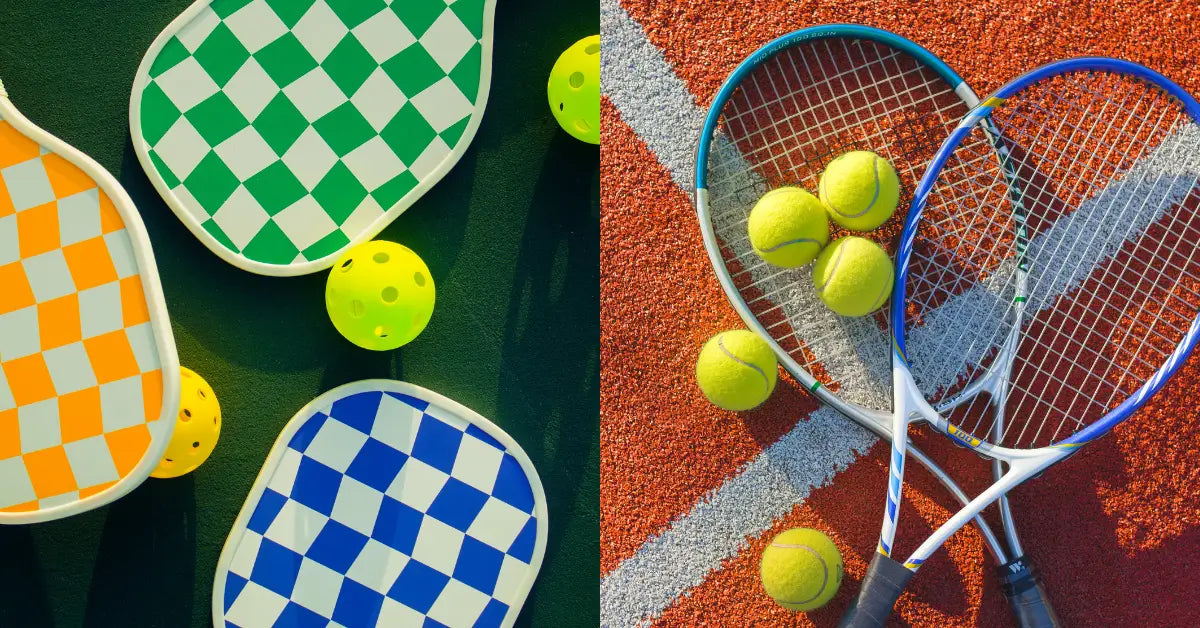
Stand at the baseline of a pickleball court for the first time and something feels familiar — the net, the lines, the opponent across from you. Then someone says "don't step in the kitchen," the serve comes underhand, and the ball makes a sound like a very disappointed Wiffle ball. Familiar and completely different, all at once.
That's the honest experience of pickleball vs tennis. They share a skeleton. Everything built on that skeleton is its own thing. If you're trying to figure out which one is worth your Saturday mornings — or whether what you already know from tennis transfers — this breakdown covers what actually matters.

The Same Net, Two Completely Different Games
Both sports use a net. Both involve hitting a ball back and forth until someone misses. That is roughly where the similarities stop mattering.
Tennis is built around distance, power, and endurance. The court is 78 feet long for singles. You're expected to cover it. Rallies can extend for 20-plus shots that require full-court sprints, and the serve alone — hit overhand with a full shoulder rotation — can take months to develop into something reliable. Tennis rewards athletic dominance. The player who hits harder, moves faster, and sustains that effort longer usually wins.
Pickleball is built around placement, patience, and angles. The court is 44 feet long and 20 feet wide — about a quarter of a doubles tennis court. Power is less decisive here. A 65-mph drive isn't going to win you many points against someone who understands positioning and shot selection. The sport rewards the player who controls the point, not the one who ends it with force.
That distinction shapes everything: who picks up each sport quickly, how your body feels the next morning, and what keeps you coming back.
Court Size, Equipment, and the Physics of a Plastic Ball
Here is the actual comparison, stripped of marketing language:
| Pickleball | Tennis | |
|---|---|---|
| Court length | 44 feet | 78 feet (singles) |
| Court width | 20 feet | 27 feet (singles) |
| Net height | 34 in. at center | 36 in. at center |
| Implement | Solid composite paddle | Strung racket |
| Ball | Hollow plastic (Wiffle-style) | Pressurized rubber |
| Bounce height | Low | High |
| Serve direction | Underhand, diagonal | Overhand, diagonal |
| Typical game length | 15–30 minutes | 45–90+ minutes |
One practical note on courts: a standard doubles tennis court can fit two pickleball courts. Many tennis facilities now stripe pickleball lines over their existing surfaces. If you're near a tennis club, there's a good chance pickleball is already there.
The ball itself changes the physics entirely. A hollow plastic ball doesn't compress or carry topspin the way a tennis ball does. You can't muscle it past someone the same way. This is why dink shots — soft, arcing balls that barely clear the net — become so important in pickleball. They're not just for beginners running out of options. At higher levels, they're weapons.
How the Rules Actually Change the Way You Play
The rules of pickleball aren't complicated, but two of them reshape the game in ways that go beyond the rulebook.
The Kitchen Rule (Non-Volley Zone)
The kitchen is a 7-foot zone on each side of the net. You cannot volley the ball — hit it out of the air — while standing in it. You can step in, but only after the ball bounces first.
This single rule prevents the serve-and-smash patterns that dominate beginner tennis. In pickleball, you cannot camp at the net and put every ball away. You earn that position through shot selection, patience, and forcing your opponent into a mistake. It also means a 45-year-old with good hands can absolutely beat a 25-year-old who relies on athleticism alone. The kitchen is why pickleball is genuinely competitive across ages and fitness levels within weeks of starting, not years.
The Two-Bounce Rule
After the serve, the ball must bounce once on each side before either team can volley. That means the receiver can't rush the net immediately, and the server can't charge forward either. It forces an exchange of groundstrokes first, which slows the early game down just enough to let both players get into position.
In tennis, there's no equivalent. The serve is a weapon — professionals hit it at 130+ mph — and the returner is immediately on defense. In pickleball, the serve is just the mechanism that starts the point.
Which Sport Is Easier to Learn — and What "Easy" Actually Means
Pickleball has a lower barrier to entry. Full stop. Most people can sustain a rally in their first session. Most people cannot sustain a tennis rally in their first session, because the serve alone is difficult enough to derail the whole experience.
That said, "easy to learn" and "easy to master" are not the same sentence. Pickleball's ceiling is real. Shot placement, kitchen-line battles, third-shot drops, stacking formations in doubles — there is genuine complexity waiting once you've been playing three months. The sport scales with you.
What makes pickleball specifically approachable for the 35–65 age range is that early competence comes fast. You don't need to spend six sessions developing a serve before the game starts being fun. You show up, you rally, you learn while playing. That accelerated feedback loop keeps people returning — which is why 223% growth over three years isn't a fluke.
What Pickleball and Tennis Do to Your Body Differently
Both sports deliver real cardiovascular and strength benefits. The difference is in how your joints and connective tissue experience them.
Tennis requires lateral sprints across a large court, explosive overhead motions, and sustained effort over longer games. The physical demand is high — and rewarding, especially for younger players. The downside for recreational players, particularly those over 40, is injury risk from overuse and the overhead serving motion.
Pickleball's smaller court reduces total distance covered per point. The underhand serve eliminates shoulder stress associated with overhead service motions. These factors make it the more accessible option for players managing existing knee, shoulder, or hip issues.
That said, pickleball has its own injury profile worth knowing about:
- Knee stress from the rapid directional changes inside a small court
- Wrist and shoulder strain from paddle mechanics, particularly with improper grip
- Pickleball elbow — the same repetitive-stress pattern as tennis elbow, just with a paddle
- Fall-related injuries — the two most common serious pickleball injuries (fractured wrist and torn rotator cuff) come from falling on an outstretched arm, not from gameplay mechanics
Neither sport is without risk. Both reward a proper warm-up, and both are dramatically safer than no activity at all.
The Real Cost of Getting Into Each Sport
Pickleball starter budget:
- Paddle: $50–$120 for a solid beginner option
- Balls: $15–$25 for a pack of outdoor balls
- Court access: Often free at community centers; $10–$20 for club drop-in
Total entry cost: $75–$165
Tennis starter budget:
- Racket: $70–$150 for a beginner racket
- Balls: $10–$20
- Court access: $15–$30/hour for public courts; club memberships run $800–$2,000/year
- Lessons: Near-mandatory for beginners; $50–$100/session
Total realistic first-month cost: $200–$400+
Both sports are affordable compared to golf. But pickleball lets you get started and actually enjoy your first session for under $100. That low threshold is a real part of why it's growing — the decision to try it costs almost nothing.
Why Tennis Players Take to Pickleball Faster Than They Expect
If you've played tennis — even recreationally — you carry transferable skills into pickleball that beginners without that background don't have. Net awareness, reading spin, footwork positioning, understanding angles: all of it applies.
What you'll need to un-learn is the instinct to go big. Tennis trains you to generate pace. Pickleball penalizes that instinct, especially at the kitchen line, where the winning shot is often the softest one in the rally. Most former tennis players describe the first month as slightly humbling — not because pickleball is harder, but because their default game style doesn't fit yet.
Paddle selection makes this transition smoother or rougher. Tennis players coming in tend to overpower the ball initially, which means a paddle with good control and a standard-weight feel matters more than one built for power generation. Velox's beginner-oriented paddles built for control and comfort are specifically designed to support this stage — giving you enough touch to develop the soft-game skills that define pickleball at every level.
If you're at the point of comparing specs, a closer look at what separates a good paddle from a frustrating one will save you from making the most common first-time mistake: buying a power paddle when you need a control paddle.
The Honest Verdict
Pickleball vs tennis isn't a competition — it's a question of fit. Tennis demands more athletically, costs more to get into, and takes longer to reach the point where it's genuinely fun. Pickleball gets you into real play within a single session, is easier on most bodies, and builds a social component into the structure of the game that tennis doesn't always deliver.
If you've been on the fence about starting pickleball, that fence is lower than you think. The barrier to your first competent rally is measured in hours, not months. Everything beyond that — the shot selection, the kitchen battles, the strategy — shows up on its own schedule.
The sport earns your time. Give it one session and see.
FAQs
Is pickleball easier to learn than tennis?
Most beginners reach a functional rally in pickleball within their first one or two sessions — a milestone that takes most tennis beginners weeks, largely because the underhand serve removes the highest technical barrier to getting started.
Is pickleball better for older adults than tennis?
For players over 50 or managing joint issues, pickleball's smaller court, lighter paddle, and underhand serve reduce the physical demands enough to make it the more sustainable long-term option — though both sports carry real fitness benefits.
Can you play pickleball on a tennis court?
Yes — a standard doubles tennis court fits two regulation pickleball courts, and many facilities paint pickleball lines directly onto existing tennis surfaces, making court access easier than most people expect.
How does pickleball scoring work compared to tennis?
Pickleball uses rally scoring to 11 (win by 2), with only the serving team traditionally able to score in recreational formats — simpler and faster than tennis's game-set-match structure, which can extend matches well past an hour.
Can you play pickleball if you have bad knees?
Pickleball's shorter court reduces the running distance per point compared to tennis, and the underhand serve eliminates overhead stress — but the sharp directional changes in kitchen-line play do put load on the knees, so proper footwear and warm-up matter.


