
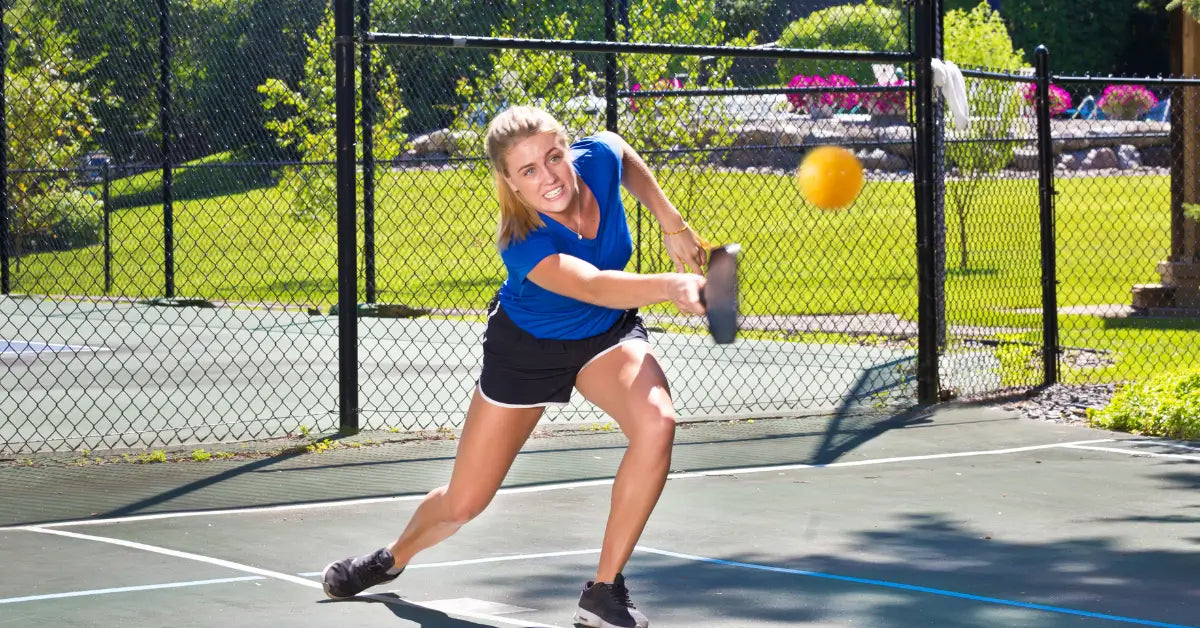
Picture two players standing at the kitchen line, tapping the ball back and forth with almost lazy patience. No power. No drama. Then, six shots in, one player's return sits up a few inches too high — and the point is over in a fraction of a second. That quiet, controlled exchange is a dink rally. And the player who understood it better just won the point.
If you've heard the term "dink shot in pickleball" and assumed it was something only advanced players worry about, that assumption is costing you points right now. The dink is not a specialty shot. It is the spine of the game.

The Rule That Made the Dink Necessary
Pickleball's most unusual feature is a seven-foot area on each side of the net called the non-volley zone — or "the kitchen." You cannot step into it and hit a ball out of the air. That single rule changes everything about how rallies are won and lost.
Without the kitchen rule, players could simply rush the net and smash everything. Tennis works partly on this principle. Pickleball does not. The kitchen rule forces both teams to earn the right to attack. You cannot generate pace off a ball that is sitting below net height, so the team that consistently keeps the ball low in the kitchen controls who gets to attack and who has to scramble.
The dink is the tool that exploits this geometry. Hit a ball softly enough that it bounces low in your opponent's kitchen, and they have a problem: they have to reach down, hit upward, and try to get it back over the net without floating it. The moment they float it, you attack. That's the entire cycle of high-level pickleball, repeated dozens of times per game.
Players who want to understand exactly what you can and cannot do in that zone often find the full breakdown of kitchen rules worth reading before diving deeper into dinking strategy.
What Is a Dink Shot in Pickleball, Exactly?
A dink shot in pickleball is a soft, controlled shot hit from at or near the kitchen line that arcs gently over the net and lands in the opponent's non-volley zone. According to USA Pickleball's official rulebook, it is "a soft shot hit on a bounce from the NVZ intended to arc over the net and land within the opposing NVZ either straight across or diagonally crosscourt."
Three details in that definition are worth sitting with.
"Hit on a bounce." Most dinks are hit after the ball has bounced — meaning you let it land in your kitchen, then redirect it. This is not a weakness. It is a mechanical choice that gives you time, control, and the ability to shape the shot.
"Arc over the net." The dink is not a flat line drive. It travels in a gentle upward curve, peaks just above net height, and then drops. That trajectory is the whole point: the ball needs to drop quickly into the kitchen, not float beyond it.
"Straight across or diagonally crosscourt." Here's a detail most beginners miss: cross-court dinking is geometrically safer than dinking straight ahead. The net is two inches lower at the center (34 inches) than at the sideline posts (36 inches), and the diagonal line is several feet longer. Cross-court gives you more margin on every dimension. This is why experienced players default to cross-court during extended dink exchanges and only shift the angle when they see a specific opportunity open up.
The mechanics of hitting one are simpler than they look. Stand at or just behind the kitchen line, knees bent, weight slightly forward. Hold your paddle loosely — grip pressure around a 3 or 4 on a scale of 10. Contact the ball in front of your body, roughly between waist and chest height. The motion comes from your shoulder, not your wrist. Think of it as a controlled lift: you are guiding the ball over the net, not pushing it.
The Part No One Tells You: Dinking Is a Mental Game
Most beginners approach a dink rally wrong before they even swing the paddle. They treat it as a pause — a waiting period before the "real" part of the point begins. That framing destroys their dinking before technique ever becomes the issue.
A dink rally is not a pause. It is the point. Every exchange is a small test: can you keep the ball low, move it to a difficult angle, and hold your position while your opponent tries to do the same to you? The player who blinks first — who swings too hard at a ball that is not sitting up for them — is the player who loses that exchange. Not the slower one. Not the less athletic one. The impatient one.
This is where dinking becomes genuinely fascinating. You are not trying to win the current shot. You are trying to build a situation where the next shot — or the one after that — becomes attackable. Think of it like a chess position: you make moves that look passive on the surface but are quietly constructing the conditions you need. A dink angled toward your opponent's backhand, followed by one pulled wide to the sideline, followed by a sharper cross-court dink can take three shots of "just tapping" to create an opening that ends the point cleanly.
What is a dink rally in pickleball, in practical terms? It's two players or two teams standing at their respective kitchen lines, trading controlled soft shots, each one watching for a response that floats even slightly too high. The moment one player's ball bounces up into a hittable position — above the net, with the opponent in position — the rally ends. The dink winner did not hit harder. They were more patient, more precise, and more strategic about shot placement.
Dinking Strategy: Where to Aim, When to Attack
Knowing how to hit a dink is one skill. Knowing where to put it is another entirely.
Aim at the feet. The most effective dink lands right at or just in front of your opponent's feet as they stand at the kitchen line. That position is extremely difficult to deal with — the player has to open their paddle face, bend low, and scoop upward, which almost always produces a ball that rises above the net. That's your window.
When to dink in pickleball versus when to attack: If the ball you receive is below net height — even slightly — dink it back. You physically cannot generate a downward attack from below the net without hitting the tape. Any attempt to do so is how points are lost. Dink the ball, reset the position, and wait. If the ball you receive is rising toward you at or above net height, that is the signal to attack. The rule of thumb: below net, dink; above net, evaluate attacking.
Use the angles. Dinking straight ahead — directly at the opponent in front of you — is the lowest percentage of the three common placements. It gives them the shortest possible reaction time. Cross-court gives you margin and moves their weight laterally. Dinking toward the middle of the court in doubles can create confusion between the two opponents about who takes the ball — especially at the 3.0–3.5 level, where communication breaks down under pressure.
The third-shot connection. One reason dinking matters even before you reach the kitchen line: the third shot drop, a key transition shot for the serving team, is essentially a long-distance dink. Once that ball lands in the opponents' kitchen and you advance to the line, you shift from drop to dink seamlessly. The mechanical feel is almost identical — shoulder-driven, open paddle face, controlled arc. Players who develop strong dinking feel in rallies find that third-shot drops improve alongside it, almost automatically.
Common Dinking Mistakes (And Why They're So Easy to Fix)
The most common dink error has nothing to do with technique — it's hitting the shot when the wrong ball is sitting up for an attack. Players at the 2.5–3.0 level especially will dink a ball that has bounced up to chest height, when they had every right and every angle to drive it. The result is a slow, floatable ball that puts you back on defense. If it's up, attack it.
Hitting too hard. The instinct to generate pace does not switch off just because the situation calls for finesse. Squeezing the grip causes the ball to pop up off the paddle face, handing your opponent an easy attack. Relax the hand. Pretend you are balancing an egg on the paddle face and need to guide it over the net without cracking it.
Contacting the ball too late. If you are letting the ball reach hip level or sink below your knees before making contact, you have missed your window. Contact should happen in front of your body, roughly at waist height. Late contact means you are fighting the geometry instead of using it.
Drifting back from the kitchen line. When your opponent hits a sharp dink that lands near your feet, the instinct is to step back. Resist this. Every foot you retreat gives your opponent a larger target area and removes pressure from the exchange. Stay at the line, bend lower, and work the ball from close range. If you do have to step back to get one, immediately move back up.
Players at this stage often start exploring how different paddle materials affect touch and control as they refine their dinking technique — there are meaningful differences between graphite, fiberglass, and carbon fiber face materials that show up most clearly in soft-game play.
How to Practice Dinking — Without a Partner
You do not need a court partner to build dinking muscle memory.
Find a solid wall and put a strip of tape at net height — 34 inches from the floor. Stand roughly seven feet back (kitchen distance) and practice tapping the ball above the tape line, catching it on the bounce, and repeating. The goal is to keep every shot within the first foot above the tape. If it comes back high and fast, you hit too hard. If it hits the tape, you aimed too low. The wall is brutally honest feedback, and you can get 50 quality repetitions in ten minutes.
Once you have a partner, try the cross-court dink game: both players stand at their respective kitchen lines, dinking cross-court only. Any ball that lands beyond the kitchen line or rises above shoulder height counts as a point for the other player. Keep score. The scoring adds just enough stakes to simulate real-match pressure, where the temptation to add pace is strongest.
Improving your dinking in pickleball is, at its core, a repetition problem — not a talent problem. The touch required comes from hundreds of repetitions, not from a single breakthrough session. Show up, do the wall drill, do the cross-court game, and your kitchen line presence will be unrecognizable in six weeks.
FAQs
What is the difference between a dink and a drop shot in pickleball?
The location of the shot is what separates them. A dink is hit from at or near the kitchen line and targeted at the opponent's kitchen. A drop shot — often called the third-shot drop — is hit from deeper in the court, usually the baseline or transition zone, and is designed to arc down into the kitchen as you advance to the net. Same destination, very different starting positions.
Is a dink an offensive or defensive shot?
Both, depending on where you place it. A dink that lands softly in the middle of your opponent's kitchen is neutral or defensive — it resets the point. A dink angled sharply toward a sideline, or aimed directly at an opponent's feet, is offensive. It is building toward an attack, not just sustaining the rally.
When should you dink instead of drive in pickleball?
Any time the ball you receive is below net height, dinking is almost always the correct choice. You cannot drive a ball downward from below the net, so any aggressive swing from that position will float high and invite an attack. Dink to reset, regain position, and wait for a ball that sits up.
What is a dink rally in pickleball?
A dink rally is an extended exchange of soft shots between players standing at their kitchen lines. Both sides are trading controlled dinks, each waiting for the other to make a mistake or float a ball high enough to attack. These rallies can last anywhere from two to twenty-plus shots and represent the strategic core of competitive pickleball.
How long does it take to learn to dink well?
Consistent wall drills and partner practice for four to six weeks will produce noticeable improvement for most players. The physical mechanics are learnable quickly. The strategic patience — knowing when to dink versus when to attack, and holding your position at the kitchen line under pressure — takes longer because it requires real-match repetitions, not just drills.
Can a dink land on the kitchen line?
Yes. The non-volley zone line is considered part of the NVZ, so a dink that lands on the line counts as landing in the kitchen. This is relevant when your opponent serves very short and the line becomes a target worth aiming for.
Why do pros dink so much more than recreational players?
Because they have learned that patience in the dink exchange wins more points than trying to end the rally early with a ball that is not ready to be attacked. Every unnecessary power shot against a ball that is sitting low costs a point. Professionals have made peace with the fact that the dink rally is the game, not the interruption to it.
Conclusion
The dink shot in pickleball is not complicated. Hit the ball softly from the kitchen line, land it in your opponent's kitchen, and keep it low. That is the definition. The game inside the definition — the patience, the placement, the geometry, the timing — is what separates players who understand pickleball from players who are still waiting for it to click.
Start with the wall drill. Get 50 reps. Then find a partner and play the cross-court dink game. Your kitchen game will follow. Once it does, every other part of your play — your third-shot drops, your resets, your attack selection — improves alongside it, because they all depend on the same foundation.


