
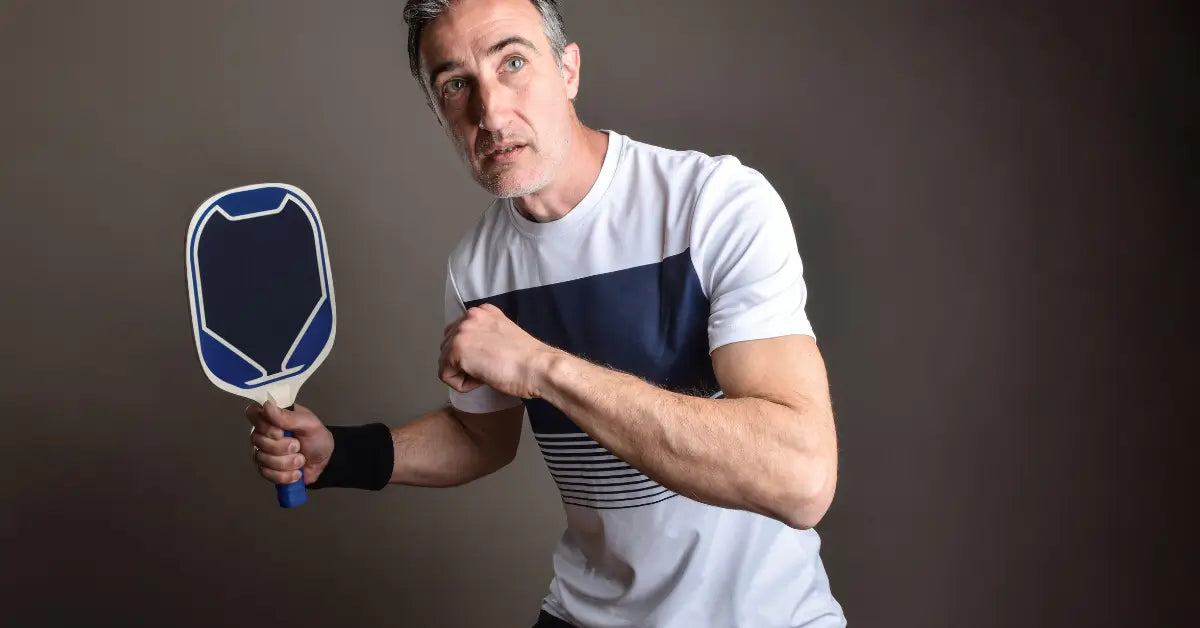
Pick up two paddles with the same number printed on their spec sheet. Swing them both. One floats. One drags. That moment — when two supposedly identical weights feel like completely different tools — is the reason pickleball paddle weight is both the most important spec you can evaluate and the most misunderstood.
Most players check the number, shrug, and move on. They're losing a real performance advantage by doing so.

Why Paddle Weight Is More Complicated Than the Number on the Box
There's a gap between the weight a manufacturer prints on the packaging and what you actually feel during a fast hands exchange at the kitchen line. That gap has a name: swing weight.
Static weight is what a kitchen scale reads. It's the number every retailer publishes — and the one most shoppers use to make their decision. Swing weight is how heavy the paddle feels when it's moving through the air toward a ball. Two paddles can share the same static weight but have completely different swing weights depending on where that mass is concentrated.
A head-heavy 7.8 oz paddle swings heavier — and generates more power — than a handle-heavy 8.1 oz paddle. On paper, it looks lighter. On the court, it plays heavier. This distinction matters the moment you're in a fast hands battle and you need to redirect the ball before your brain has finished issuing the instruction.
There's another layer: manufacturers' published weights carry a built-in margin. Most paddles ship within ±0.3 oz of their stated weight because tiny construction variables — adhesive application, grip tape thickness, edge guard placement — all add up. The paddle you order at 7.6 oz might arrive at 7.4 or 7.8. Advanced players who've dialed in a precise weight preference know this, which is why many purchase slightly under their target and dial up with lead tape. For most recreational players, this margin is irrelevant. Worth knowing, though, before you obsess over a 0.2 oz difference between two models.
The real takeaway: treat the published weight as a starting zone, not a precise specification.
The Three Weight Classes of Pickleball Paddles — What Each One Actually Does
Every paddle on the market clusters into one of three weight ranges. The labels vary slightly by brand, but the physics underneath them don't.
Lightweight Paddles: Under 7.5 oz
A paddle in this range moves fast. That's the primary promise. Faster swing means faster reaction at the net, which matters enormously when your opponent fires a speed-up from six feet away and your margin for error is measured in milliseconds. Net-first players who live on dinks, resets, and flick volleys often gravitate here.
The trade-off gets underplayed in most guides. Lighter paddles have less mass behind them, so when a hard-driven ball arrives, there's less resistance absorbing the energy. The result is more vibration transferred up through the handle into the wrist and forearm. For players managing elbow sensitivity, this is the opposite of helpful — and the common advice to "go lighter for arm pain" is, in many cases, exactly wrong. More on that shortly.
Lightweight paddles also reward precise contact. Miss the sweet spot by a centimeter and the paddle twists noticeably in your hand. There's less stability, which some players feel as a lack of confidence.
Midweight Paddles: 7.5–8.2 oz
This is where most players land, and for good reason. The midweight range does something neither extreme can: it lets you drive the ball with authority and get your paddle into position at the net without feeling like you're dragging a brick. The power is there. The hand speed is there. Neither is fully compromised.
There's a reason midweight paddles dominate tournament play at recreational and intermediate levels. They're forgiving of slight timing errors, stable enough to absorb incoming pace, and maneuverable enough to compete in rapid exchanges. If you're genuinely unsure which weight class fits your game, start midweight — specifically somewhere in the 7.6 to 8.0 oz range — and let your play patterns tell you what adjustment, if any, to make next.
One practical note: midweight paddles also give you the most flexibility for future customization. You can always add a few strips of lead tape to increase swing weight or stability. You cannot make a heavier paddle lighter. Starting midweight means you've kept your options open.
Heavyweight Paddles: 8.3 oz and Above
Heavier paddles generate power through mass. The physics are simple: more momentum behind the ball at impact equals more pace coming off the face. You don't have to swing harder — the weight does the work for you. This is why experienced singles players and former tennis players who drive aggressively tend to find comfort here. The longer rallies in singles play also make power at the baseline more valuable relative to net speed.
The cost is real, though. Reaction time at the kitchen line slows. Arm fatigue accumulates faster over a long session. And if your form isn't already clean, the extra mass in a head-heavy paddle amplifies wrist stress rather than reducing it. A heavier paddle in the wrong hands, with imprecise mechanics, is a path toward elbow problems — not away from them.
The Counterintuitive Truth About Paddle Weight and Arm Health
This is the part that doesn't get said clearly anywhere.
If your elbow or wrist is bothering you, the instinct is to grab the lightest paddle you can find. Lighter means less stress, right? Not necessarily. A lightweight paddle lacks the mass to absorb energy on impact. When a firm shot lands on the face, the vibration travels directly into your hand, forearm, and elbow rather than being dampened by the paddle's own mass. A 6.9 oz paddle with a thin core can punish your elbow far more aggressively than a well-balanced 7.9 oz paddle with a thick core.
What actually protects arm health is a combination of three things: weight in the right range (7.6–8.0 oz is the sweet spot for most players managing discomfort), a thicker core that absorbs vibration, and a balance point that doesn't load the wrist on every swing.
Head-heavy paddles are the specific culprit most people miss. A top-heavy paddle forces your wrist and forearm to stay constantly active — stabilizing, correcting, resisting — which is exactly the kind of repetitive low-level strain that builds into a tendon problem over weeks of regular play. An evenly balanced paddle in the midweight range asks far less of your arm between shots.
If you've been dealing with nagging elbow pain and you're playing with either a very light paddle or a head-heavy one, try the midweight first before changing anything else.
How Your Game Style — and Playing History — Should Shape Your Choice
There's a useful shortcut that most guides skip entirely: where you came from before pickleball.
Former tennis players almost always adapt faster with a midweight-to-heavy paddle. Tennis racquets weigh 10–11 oz strung; the transition to a 7.9 oz pickleball paddle feels light by comparison, and the swing mechanics transfer well. Many tennis converts actually underperform with lightweight paddles early on because they're used to generating power through mass, and a light paddle rewards a completely different contact style.
Badminton and table tennis players run the opposite direction. Those sports reward explosive wrist flicks and rapid repositioning — skills that map directly onto a lightweight paddle's strengths at the kitchen line. A heavy paddle feels sluggish and fights the instincts these players have spent years building.
If you're newer to paddle sports altogether, default to midweight. There's no ingrained habit to contradict.
Session length matters more than most players acknowledge. A 45-minute recreational game and a three-hour doubles tournament are different physical asks. A paddle that feels perfectly manageable at 7:30 PM can feel like a weight workout by game six of a round-robin. Players who know they'll be on court for extended stretches should shade toward the lighter end of their comfort zone, not the heavier.
Singles vs. Doubles: The Weight Strategy Difference
Singles pickleball and doubles pickleball reward slightly different things, and weight plays into that gap.
In doubles, the point is often decided at the kitchen line in a rapid-fire exchange. Net speed and reaction time are at a premium. A slightly lighter paddle — or at minimum a handle-balanced midweight — gives you the half-step advantage that often determines who wins those scrambles.
In singles, the court is wider, rallies run longer from the baseline, and power matters more. Drives and deep returns keep opponents pinned. Heavier paddles are more at home in singles play, and it's no coincidence that many competitive singles players play at the top of the midweight range or just above it.
Matching Your Weight Choice to the Game You're Actually Playing
Here's a practical framework — one you can apply before you ever pick up a paddle.
Answer three questions. First: how do you primarily score points? If you win at the net with touch and placement, lean light-to-midweight. If you win with pace from the baseline or a powerful serve, lean mid-to-heavy.
Second: what's your arm situation? Any existing elbow, wrist, or shoulder sensitivity? Stay firmly in the 7.6–8.0 oz range with even balance and a thick core. No existing issues and good general arm strength? The full midweight-to-heavy range is available to you.
Third: how long do you typically play? Sessions under an hour give you more flexibility. Longer sessions favor a lighter paddle, or at minimum, a balanced one that doesn't concentrate load in the head.
Once those three answers are on paper, the weight range that fits you becomes obvious. Players at this stage often find a good paddle comparison guide useful for narrowing their options across materials and shapes within their chosen weight zone. And once you have a target range, you can explore a curated paddle lineup filtered by weight to see what's actually available within your window.
One last practical note: start at the lighter edge of your target range. You can always add lead tape in small increments — three grams at 3 and 9 o'clock on the paddle face increases stability without dramatically shifting balance. You cannot subtract weight from a paddle you've already bought. Buying slightly under your ideal and dialing up is always the smarter move.
Common Mistakes That Send Players Toward the Wrong Weight
The most common error is buying on feel in a store — picking up a paddle cold, with no arm fatigue, after no play, and assessing whether it feels right. Paddles feel different during a 45-minute session than they do in a shop. A paddle that feels light and fast at rest can feel slow and heavy after twenty minutes of sustained volleys. Always account for the fatigue factor when evaluating weight.
The second mistake is chasing what a better player uses without context. A 4.5-level player recommends their 8.4 oz head-heavy paddle. They've built the arm strength, refined the mechanics, and play four times a week. Adopting that setup at a 3.0 level is likely to produce elbow pain within a month, not better results.
Third: ignoring balance point entirely and fixating only on static weight. A 7.9 oz head-heavy paddle and a 7.9 oz handle-balanced paddle play like different weight classes. Before you buy, check whether the brand publishes balance point or swing weight data. The ones that do are usually being more honest about their product's actual performance characteristics.
Finally — and this applies to intermediate players specifically — resisting weight adjustments too long. Your game evolves. The paddle you chose at a 2.5 level may not serve you at 3.5. As your technique improves, your arm handles more weight, and your shot patterns change. What worked eighteen months ago is worth revisiting.
Conclusion
Pickleball paddle weight isn't a single number. It's a combination of static mass, balance point, swing weight, and how all three interact with your body, playing history, and session length. The midweight range — roughly 7.5 to 8.2 oz — is the best starting point for the majority of players, offering enough stability for confident drives while keeping hand speed viable at the net.
Start there. Play enough sessions to feel what your game is asking for. Then adjust — deliberately, one variable at a time. Weight is one of the easiest specifications to optimize for, once you understand what you're actually trying to solve.
FAQs
What is the best weight for a pickleball paddle?
For most players, the 7.5–8.2 oz midweight range offers the best balance of power, control, and arm-friendly stability — enough mass to drive confidently without sacrificing reaction speed at the net.
Does a heavier pickleball paddle give more power?
Heavier paddles carry more momentum through the ball, generating more plow-through power on drives, but the advantage shrinks as you approach the kitchen line where hand speed determines the outcome.
Is a lighter pickleball paddle better for tennis elbow?
Going lighter often makes elbow problems worse, not better, because a light paddle lacks the mass to absorb impact energy, sending more vibration directly into your forearm and tendons — a balanced midweight paddle with a thick core is the better choice.
What oz do pickleball pros use?
Elite tournament players typically play between 8.0 and 8.5 oz, and many add lead tape to push static weight to the top of that range — though their arm conditioning makes that practical in ways it often isn't for recreational players.
What is swing weight in pickleball and why does it matter?
Swing weight describes how heavy a paddle feels when moving through the air, which is determined by where the mass is positioned, not just how much there is — two 8 oz paddles can feel completely different mid-swing depending on their balance point.
Can I add weight to my pickleball paddle?
Lead or tungsten tape applied in small increments to the edges or throat of the paddle lets you increase swing weight and stability with precision — buying slightly under your target weight and adding tape is standard practice at every level.
How does paddle weight affect pickleball performance for beginners?
Beginners typically benefit most from the 7.6–8.0 oz range, where the paddle is forgiving enough to build confidence without demanding the precise mechanics that make very light or very heavy paddles work as intended.


