
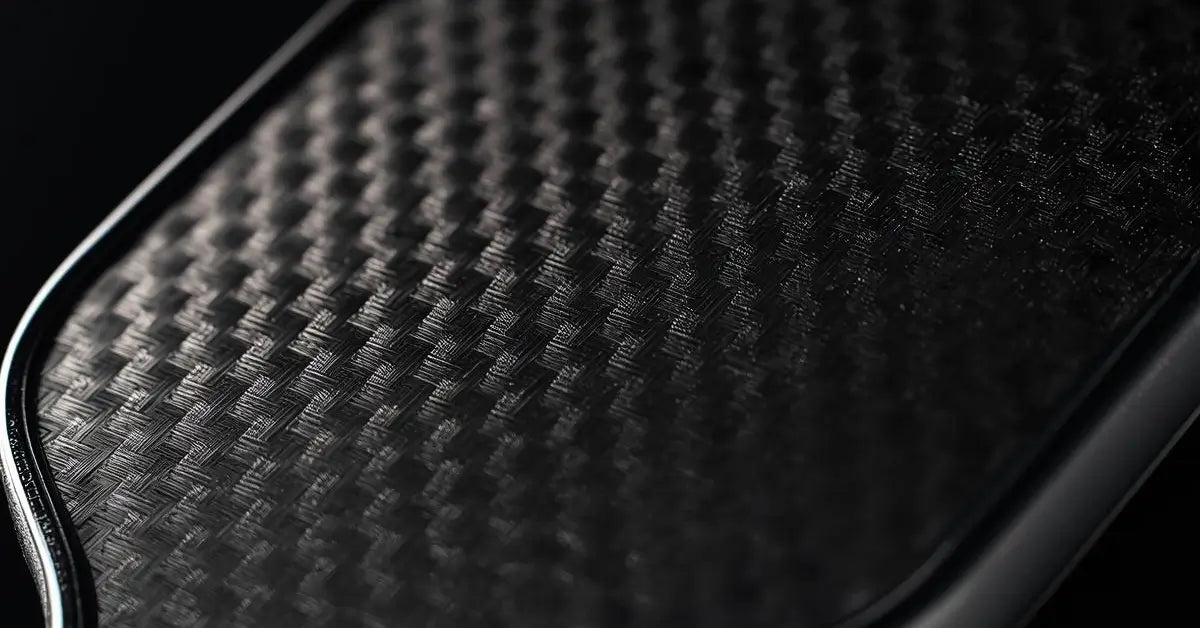
Pick up a paddle at your local court and you'll hear three words used interchangeably: graphite, carbon fiber, composite. Most players nod along without a clear picture of what those words actually mean — or why one paddle feels like a wall and another like a trampoline off the same swing.
Understanding what pickleball paddles are made of isn't just trivia. It's the difference between buying a paddle that fights your game and one that fits it. Here's what you actually need to know.

The Two-Layer Structure Most Players Never Think About
Every modern pickleball paddle is built in two distinct layers: the face (the hitting surface you can see) and the core (the interior structure that determines feel, power, and vibration). Most players shop by face material. That's a mistake.
Why the face and core work as a system, not separately
A stiff carbon fiber face behaves completely differently depending on what's underneath it. Pair it with a firm, thin core and you get explosive pop — ball leaves fast, feedback is crisp. Pair the same face with a thick, soft polymer core and suddenly you have a paddle that absorbs pace beautifully, perfect for resets and dinking at the kitchen.
This is why two paddles labeled "carbon fiber" can play nothing alike. The face sets the ceiling; the core determines how you live within it.
Pickleball Paddle Face Materials Explained
The face is your direct contact point with the ball. It shapes spin, touch, and how much feedback travels up the handle into your hand. Four materials dominate the market right now.
Graphite — touch and feedback above everything else
Graphite faces are fingernail-thin — sometimes less than a millimeter — and extremely rigid. That rigidity is the point. When you hit a dink or a drop shot, a graphite face gives you honest feedback: you feel exactly where on the face the ball contacted, which lets you make small adjustments every rally.
The tradeoff is that graphite doesn't generate power on its own. You bring the swing, the paddle redirects it. For players who prefer finesse over force — anyone who's been told they need more "touch" at the kitchen — graphite is worth considering seriously.
Carbon fiber — the modern upgrade that earns the price
Carbon fiber is technically a form of graphite, but the construction is different. Where graphite is compressed layers, carbon fiber is woven ribbons interlocked under heat and pressure. The result is lighter, stronger, and more consistent across the paddle face.
The practical difference on court: carbon fiber paddles tend to have a slightly larger effective hitting zone than graphite and hold up better over time. Textured carbon fiber faces — now standard on most control-oriented paddles — also grip the ball longer at contact, producing more spin with less effort. If you're in the $100–$180 range and choosing between graphite and carbon fiber, carbon fiber wins on almost every metric except price sensitivity.
Fiberglass — power and forgiveness for rec play
Fiberglass faces are softer and more flexible than carbon-based surfaces. When the ball hits, the face flexes slightly before snapping back — that flex is what creates the trampoline-like power response fiberglass is known for. You'll generate more pace on drives without needing a full swing.
The flip side: fiberglass tends to concentrate that energy in a smaller sweet spot than carbon fiber, and off-center hits lose more power. For players still building consistent contact mechanics, that smaller sweet spot can be frustrating. Fiberglass is best suited for recreational players who want easy power and don't yet need the precision feedback of stiffer materials.
Composite and hybrid faces — when manufacturers blend materials
A composite face combines two or more materials — usually fiberglass with carbon fiber or graphite — to capture the strengths of each. Most mid-range paddles sold today are technically composites, even if they're marketed under a single material name.
Hybrid construction allows brands to tune specific performance characteristics: a fiberglass base for power with a thin carbon layer on top for added spin texture, for example. When a paddle description mentions "T700 carbon" or "raw carbon fiber weave," that's a specific fiber grade — not marketing language. T700 is a medium-strength aerospace carbon commonly used in high-performance paddles in the $120–$200 range.
What's Inside the Paddle: Core Materials and Why Polymer Won
The core is invisible until your paddle cracks open on a fence post. But it shapes every shot you'll ever hit with that paddle.
Polymer honeycomb — why it became the industry standard
Over 85% of paddles sold today use a polypropylene honeycomb core — commonly called poly core or polymer core. The structure is exactly what it sounds like: a grid of hexagonal cells made from a plastic blend, bonded between two face sheets.
Polymer won because it solves three problems at once. It's quiet (critically important in residential pickleball communities), it absorbs vibration better than any competing material, and it offers a soft, controllable feel that suits a wide range of skill levels. The cell size matters too: smaller cells (around 6mm) produce a firmer, more controlled feel; larger cells (10mm) generate more power but with less consistency. Most consumer paddles use 8mm cells as the default compromise.
Nomex — the older, louder, harder option
Nomex is an aramid fiber originally developed for military gear, first used in pickleball cores in the 1970s. It's coated in resin and structured in a tight honeycomb that's significantly harder than polymer. The result: fast, powerful, loud.
Nomex paddles generate excellent ball speed, but that hardness means less vibration damping and more noise — not ideal for courts near homes or community spaces. They're rare today outside niche players who specifically want that explosive, board-like response. If you play in a noise-restricted area, Nomex is simply off the table.
How core thickness (14mm vs. 16mm) changes what the material does
A 16mm core feels softer and more forgiving than a 14mm version of the exact same material. That extra 2mm of depth absorbs more energy, expands the sweet spot, and makes off-center hits more recoverable. A 14mm core plays firmer, gives more pop, and rewards clean contact — but punishes mishits more visibly.
This distinction matters most in the polymer core category, where the material stays the same but thickness dramatically shifts the paddle's character. Core thickness is a decision that deserves its own attention — our breakdown of 14mm vs. 16mm paddle differences covers the full picture if you're trying to narrow between two specific models.
How Face + Core Combinations Shape Your Game
Think of it as a dial between power and control — and the face and core each turn it in one direction.
A stiff face (carbon fiber or graphite) + thin, firm core = maximum control and feedback. You're responsible for generating pace. Every shot goes where you put it, but nothing happens automatically.
A flexible face (fiberglass) + thicker, softer core = easier power, larger margin for error, more forgiving off-center. Less feedback, less precision at the extremes.
The combinations most beginners and intermediates actually benefit from: a carbon fiber or textured composite face paired with a 16mm polymer core. That pairing gives you the spin texture of modern carbon fiber surfaces with the forgiving, quiet feel of a soft polymer interior. It's not a compromise — it's the configuration the majority of well-designed recreational paddles are built around for exactly this reason.
Which Material Combination Makes Sense for Where You Are Right Now
If you're new to the sport and rally consistency is your main challenge: a fiberglass or composite face with a 16mm polymer core gives you the most forgiving platform. You'll generate pace without overthinking your swing, and mishits won't punish you as severely.
If you're an intermediate player starting to develop a kitchen game: a textured carbon fiber face with a 16mm polymer core is the current sweet spot of the market. It gives you spin capability, touch feedback, and enough softness to reset pace when you need to.
If you're playing competitively and you already know your tendencies: graphite or raw carbon fiber faces with a 14mm core reward clean mechanics and precise shot-making. Nothing works for you here unless your fundamentals can support it.
The material knowledge you've just built is the foundation. Once you know what you're looking for, browse paddle options that match what you've just learned about materials and filter by face type and core thickness — those two specs alone will cut the decision in half.
The honest answer to "what are pickleball paddles made of" is this: a face that determines feel and a core that determines character, working together. Most players spend years wondering why paddles feel so different without realizing they're comparing entirely different material combinations. Now you're not one of them.
FAQs
What is the most common pickleball paddle material?
Polypropylene honeycomb (polymer) cores make up roughly 85–90% of paddles sold today, paired with carbon fiber or composite faces in most mid-range models.
Is carbon fiber better than graphite for pickleball?
Carbon fiber offers greater durability, a slightly larger sweet spot, and better spin texture than graphite — at a higher price point — making it the stronger choice for most players upgrading from a starter paddle.
What are the inside cores of pickleball paddles made of?
Most cores are polypropylene honeycomb plastic; Nomex (a resin-coated aramid fiber) is a harder, louder alternative still used by a small segment of power-oriented players.
Does core thickness matter as much as face material?
Core thickness changes how any face material performs — a 16mm polymer core feels softer and more forgiving than a 14mm version of the same core, even with an identical face.
What paddle material is best for beginner pickleball players?
A fiberglass or composite face with a thick polymer core gives beginners the largest sweet spot, easiest power generation, and most forgiving response on off-center contact.
What does a graphite paddle feel like compared to fiberglass?
Graphite feels crisp and precise — you sense exactly where the ball hit — while fiberglass feels bouncier and more powerful, with less specific feedback per shot.
How long do pickleball paddles last?
Most polymer-core composite paddles last 1–3 years of regular play before the face delaminates or the core compresses; performance degradation usually appears as a dead, muted sound on contact.


