
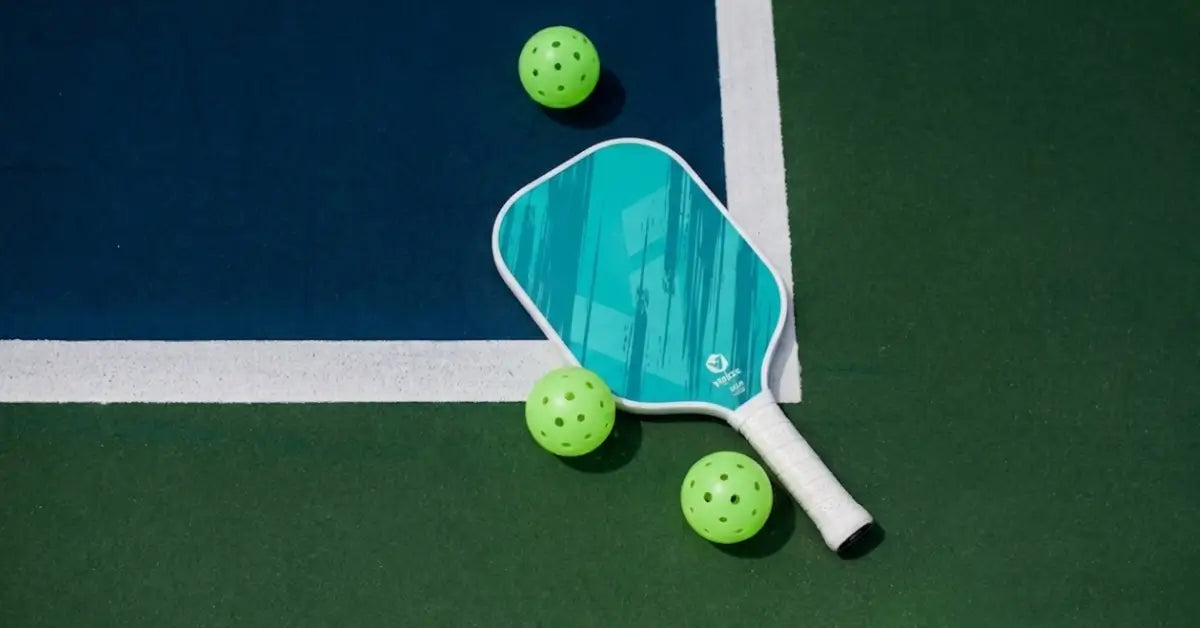
You step onto the court for the first time thinking you'll play for twenty minutes. Two hours later, you're scheduling your next session on the drive home. That's pickleball. And if you've been hearing the name everywhere lately — at the gym, from your neighbor, on the news — here's everything you need to know to understand what pickleball actually is, how it works, and why it's become the fastest-growing sport in America.

Pickleball in Plain Terms: A Sport That Actually Makes Sense
Pickleball is a paddle sport played on a compact court with a perforated plastic ball and solid paddles roughly the size of an oversized ping-pong bat. It borrows the underhand serve from badminton, the net and rally structure from tennis, and the feel of table tennis in your hands — but the result is something entirely its own.
The court is smaller than a tennis court, which means less running. The ball travels slower, which means more time to think. The rules have just enough structure to reward strategy without overwhelming a first-timer. That combination is exactly why people in their 30s, 50s, and 70s are all playing the same sport at the same facility on the same afternoon — and actually having a fair contest.
How It Started: Three Bored Dads on Bainbridge Island
In the summer of 1965, Washington congressman Joel Pritchard and businessman Bill Bell came home from a round of golf to find their kids with nothing to do. The property had a badminton court, but no racquets. So they improvised — table tennis paddles, a perforated plastic ball, and a net they eventually lowered to 36 inches. Their friend Barney McCallum joined the following weekend, and the three men wrote the first rules together.
The name came from the Pritchard family's dog, Pickles, who had a habit of chasing the ball — though some historians trace it to the term "pickle boat," a rowing term for a crew assembled from leftover oarsmen. Either way, the game that started as a backyard fix for boredom now has an estimated 36 million players in the United States and a global market projected to reach $9.1 billion by 2034.
The USA Pickleball Association (USAPA) was founded in 1984 to formalize the rules. That institutional backbone is part of why the sport scaled cleanly — there's a single authoritative rulebook, organized amateur play, and now a fully professional tour.
The Court, the Net, and the Kitchen: What You're Actually Playing On
A pickleball court measures 20 feet wide by 44 feet long — the same footprint as a doubles badminton court, which means many facilities simply repurpose existing spaces. The net sits at 36 inches at the sideline posts and drops to 34 inches at the center.
The court is divided into several zones you need to know:
- The baselines — the back lines where you stand to serve
- The service areas — two boxes on each side, separated by a centerline; serves must land cross-court in the correct box
- The sidelines — the outer boundary running the length of the court
- The non-volley zone — the 7-foot area on each side of the net, universally known as the kitchen
The Kitchen: The Rule That Changes Everything
You cannot hit the ball out of the air while standing inside the kitchen. You can step in to play a ball that bounces there, but volleying — hitting the ball before it bounces — from inside that zone is a fault. This single rule does more to shape the strategy of pickleball than any other.
It keeps powerful players from camping at the net and ending rallies with pure aggression. It rewards patience, soft hands, and angle. Two players trading gentle shots just above the net at the kitchen line — a sequence called a dinking rally — can look almost leisurely from the outside. Inside the game, it's some of the most intense, precise competition the sport offers.
The Rules That Make Pickleball Pickleball
The basic rules are learnable in under ten minutes, which is one of the sport's real strengths. Here's what governs every rally.
The Two-Bounce Rule
After the serve, the receiving team must let the ball bounce before returning it. Then the serving team must also let that return bounce before they hit it. After those two mandatory bounces, both teams can volley freely. This rule prevents the serving team from rushing the net immediately and creates a built-in transition phase at the start of every point.
It rewards smart positioning over raw athleticism — and it's why pickleball can feel genuinely competitive between players of different fitness levels.
Scoring
Points can only be scored by the serving team. Games are typically played to 11, win by 2. In doubles, both players on a team get to serve before the serve rotates to the opposing team — with one exception: the team serving first in a game starts with only one serve. The score in doubles is always called as three numbers: serving team's score, receiving team's score, and which server is currently serving (1 or 2).
It sounds complicated until you play your first three games. Then it's automatic.
What You Need to Play (It's Less Than You Think)
The barrier to entry is low. To get on a court and play a real game, you need:
- A paddle — solid composite or carbon fiber body, not strung like a tennis racquet; weight typically ranges from 7.2 to 8.5 oz, with lighter paddles favoring control and heavier ones adding power
- A pickleball — indoor balls have larger holes and a softer feel; outdoor balls are denser with smaller holes to handle wind
- Court shoes — lateral support matters on the quick side-to-side movement; running shoes are a sprain risk
- A court — many parks, recreation centers, and YMCAs have permanent or marked courts; the Places2Play database lists thousands of public options across the US
If you want a ready-to-play setup without choosing individual pieces, the Velox Paddle Set of 2 includes a complete paddle set designed for players just getting started — paddles and balls included, with the grip weight and surface texture suited to early-stage play.
Why 36 Million Americans Picked Up a Paddle
Pickleball grew 222% over a three-year stretch that included the pandemic. Courts went up faster than any sport infrastructure in recent memory. But the numbers alone don't explain why people stayed.
The real answer is that pickleball solves a problem tennis never fully cracked: it's social in a way that most sports aren't. Four players on a court about the size of two parking spaces, rallies that regularly run 15 or 20 shots, and a culture that actively welcomes strangers into open play. Show up alone to a pickleball session at a local rec center and you'll have a game within five minutes.
It also travels well across age groups in a way that is genuinely unusual. A 35-year-old playing competitively and a 62-year-old who picked it up six months ago can share a court and both enjoy it. That's not spin — it's the physics of the sport. The smaller court and slower ball compress the gap between athletic ages. You're not outrunning your opponent; you're outthinking them.
The Part Nobody Tells Beginners: There's a Real Skill Ceiling
Here's the thing that surprises most new players: pickleball is easy to start and hard to master.
The first game feels accessible because the court is small and the ball is forgiving. But the skill curve — once you start playing consistently — is steep and genuinely rewarding. Controlling a dink within an inch of the kitchen line, developing a reliable third-shot drop from the baseline, reading your opponent's paddle angle before they make contact — these take real repetition to build.
That depth is why the sport keeps people for years, not just weeks. And it's why your equipment eventually matters. At the beginner stage, almost any decent paddle works. As your game develops, players start looking at paddle comparison guides that match weight and core to their play style — because the difference between a 13mm and 16mm core, or a raw carbon face versus fiberglass, actually shows up in how you play at an intermediate level.
Pickleball starts as something you can learn in a day. It becomes something worth playing for decades.
The Real Answer
Pickleball is a paddle sport that earns its reputation for being easy to start — but it earns its players' loyalty by being difficult to truly master. A compact court, a handful of rules, a ball that rewards placement over power, and a culture built around shared courts and open play. That's what pickleball is.
If you've been curious, the best next step isn't reading more about it. Find a court near you, show up to an open play session, and borrow a paddle from someone there. You'll understand in twenty minutes what this article has been trying to describe.
FAQs
Is pickleball easy to learn for a complete beginner?
Most beginners can rally consistently after a single 60-minute session — the court is compact, the ball is slower than a tennis ball, and the basic rules take under ten minutes to absorb.
How long does a pickleball game last?
A recreational singles or doubles game to 11 points typically takes 15 to 25 minutes, though close matches with experienced players can run longer.
Can you play pickleball on a tennis court?
A standard tennis court fits four pickleball courts side by side, and many facilities use temporary tape or portable nets to convert tennis courts for pickleball play.
What is the kitchen in pickleball?
The kitchen is the informal name for the 7-foot non-volley zone on each side of the net — players cannot hit the ball out of the air while standing inside this zone.
How many players are on a pickleball court?
A doubles game has four players total — two per side — while singles is played one-on-one; most recreational and organized play is doubles.


