
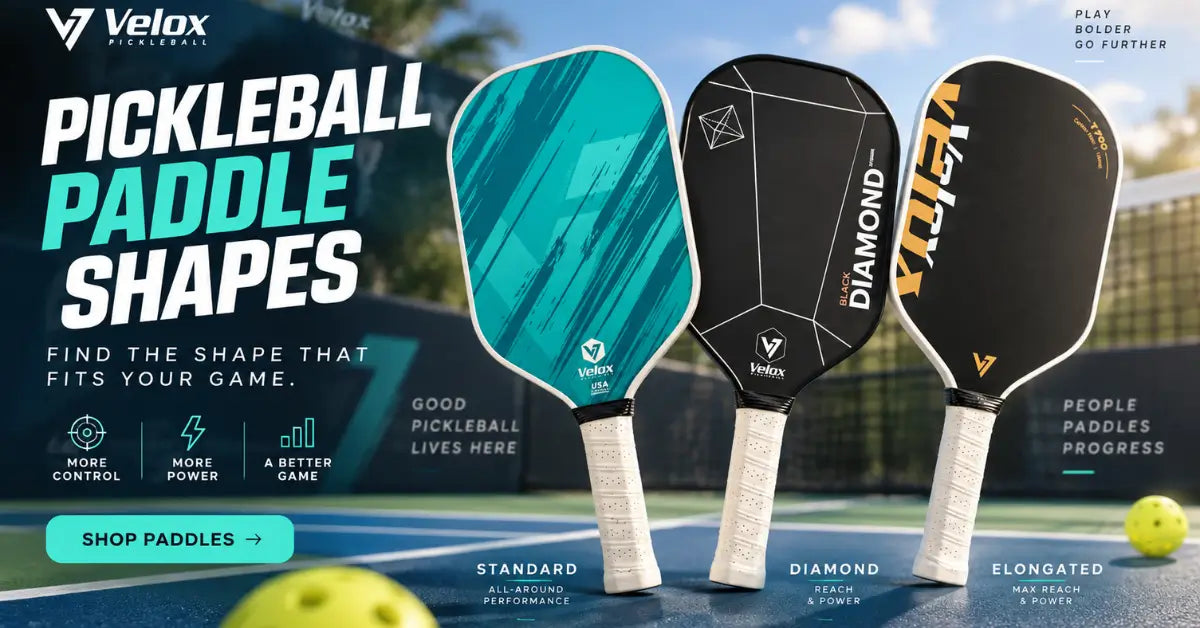
You pick up two paddles, both labeled "hybrid," both roughly the same price, and they feel like completely different pieces of equipment in your hand. That's not your imagination. Pickleball paddle shapes are supposed to tell you what you're buying, and half the time the label is only loosely connected to reality.
Once you know what to actually measure, the confusion mostly disappears.
The Three Shapes, and What Actually Changes Between Them
Every paddle on the market falls somewhere on a spectrum between two extremes, with a middle category that's absorbed most of the growth in recent years.
| Shape | Typical Dimensions | Sweet Spot | Swing Weight | Best For |
|---|---|---|---|---|
| Widebody | ~16" x 8" | Largest, most forgiving | Lowest, fastest hands | Quick net exchanges, off-center contact |
| Hybrid | ~16"–16.3" x 7.75"–7.8" | Moderate, slightly higher on face | Middle | All-around play, most players |
| Elongated | ~16.5" x 7.5" | Smallest, highest on face | Highest, slowest hands | Reach, drives, serve power |
The width you lose by going longer isn't cosmetic. It's the entire tradeoff in one measurement — every extra half-inch of length borrows real estate from the face, and that missing width is exactly where a widebody paddle forgives you for a slightly off-center hit.
Pickleball paddle shapes fall into three categories: widebody paddles maximize sweet spot size and hand speed, elongated paddles maximize reach and power through added length, and hybrid paddles blend both traits in a single frame. The right shape depends on your swing, your reach needs, and how much forgiveness your current contact requires.

Why the Same Shape Name Means Different Things Across Brands
Here's the part that trips up even players who've done their homework: "hybrid" isn't a regulated term. One brand's hybrid measures closer to a widebody. Another brand's hybrid is practically an elongated paddle with a different sticker.
USA Pickleball only regulates two numbers — combined length plus width can't exceed 24 inches, and length alone can't exceed 17. Everything else, including what a manufacturer chooses to call the shape, is marketing.
Check the actual length and width printed on the product page before you trust the category name. A paddle sold as "hybrid" at 16.4 inches long is functionally closer to elongated than a "hybrid" at 16 inches flat.
Where You Miss the Ball Tells You More Than Your Style Does
Most shape guides ask what kind of player you want to be. A more honest question is where your paddle actually makes contact when things go wrong.
If your mishits cluster near the tip of the paddle, you're probably reaching or extending on shots, and a longer face — hybrid or elongated — gives you more usable surface exactly where you're already swinging.
If your mishits scatter toward the edges instead, a widebody's extra width is forgiving you in the dimension you actually need forgiveness in.
Watch your next few games for this pattern instead of guessing. It's a five-minute diagnosis that most players never bother running before they buy.
Does Shape Actually Matter at the Beginner Level?
Here's an honest answer most gear guides won't give you: for a brand-new player, shape is probably the fourth or fifth most important spec on the paddle, not the first.
Weight and grip size affect your arm and your control on every single shot. Shape mostly affects the margins — a slightly bigger sweet spot, a slightly longer reach — margins that matter more once your contact is already fairly consistent.
That doesn't mean shape is irrelevant. It means a beginner chasing the "right" shape before nailing down weight and grip is optimizing the wrong variable first.
Intermediate players are a different story. Once your contact is consistent enough that you're actually reaching the edges of your sweet spot, shape starts deciding real points instead of just theoretical ones.
The Physics Behind Why Longer Paddles Hit Harder
An elongated paddle isn't more powerful because of the material in the face. It's more powerful because of basic leverage.
A longer paddle creates more tip speed for the exact same swing arc, the same way a longer lever arm amplifies force at its end. That's why two paddles built from identical carbon fiber and identical core thickness can still feel completely different in hand — the shape alone is doing real mechanical work.
The tradeoff is that same length adds swing weight, which is why elongated paddles feel slower to reset at the net even though nothing about the core changed.
Shape Is Only One Piece of the Puzzle
Shape interacts with weight and core thickness constantly, which is why comparing shape in isolation only gets you partway to the right paddle.
A heavy elongated paddle and a light elongated paddle play like different tools despite sharing a shape category. If you haven't settled on a target weight yet, our breakdown of pickleball paddle weight is worth reading before you lock in a shape.
The same logic applies to core thickness, which changes how forgiving or lively a paddle feels independent of its outline.
Players narrowing down their first real paddle often work through our full guide to choosing a pickleball paddle to see how shape, weight, and thickness fit together instead of picking one spec in isolation.
Picking a Shape When You're Ready to Buy
If you genuinely can't decide, hybrid is the safer default. It's the shape most players settle into after trying the extremes, which is exactly why it's absorbed so much of the market in the last few years.
That's not a compromise so much as an admission that most rec-level games don't demand the far end of either spectrum.
Players ready to browse rather than research further can look at Velox's hybrid paddle lineup for options that split the difference between reach and forgiveness instead of committing hard to either extreme.
The Velox Elite Pickleball Paddle is built for exactly that balance, giving you real drive power without abandoning the forgiveness a newer player still needs on off-center contact.
Match the Shape to Your Miss, Not the Marketing
The three-shape breakdown is real, but the label on the throat of the paddle matters less than the actual dimensions printed underneath it. Widebody, hybrid, and elongated describe a spectrum, not three fixed products.
Figure out where you're actually missing the ball before you figure out what shape sounds most appealing in a product description.
FAQ
What shape pickleball paddle is best for beginners?
Widebody paddles are usually the easiest starting point because their larger sweet spot forgives the off-center contact new players make most often.
Is an elongated or widebody paddle better?
Neither is universally better — elongated gives you more reach and power, while widebody gives you a bigger sweet spot and faster hands at the net.
Does pickleball paddle shape really matter?
It matters more as your contact becomes consistent; for true beginners, weight and grip size usually affect your game more than shape does.
What's the difference between hybrid and elongated paddles?
Hybrid paddles balance reach and forgiveness in one frame, while elongated paddles push further toward length and power at the cost of sweet spot size.
Why do two paddles with the same shape name feel different?
Shape category names aren't standardized across brands, so the actual printed length and width matter more than the label itself.


