
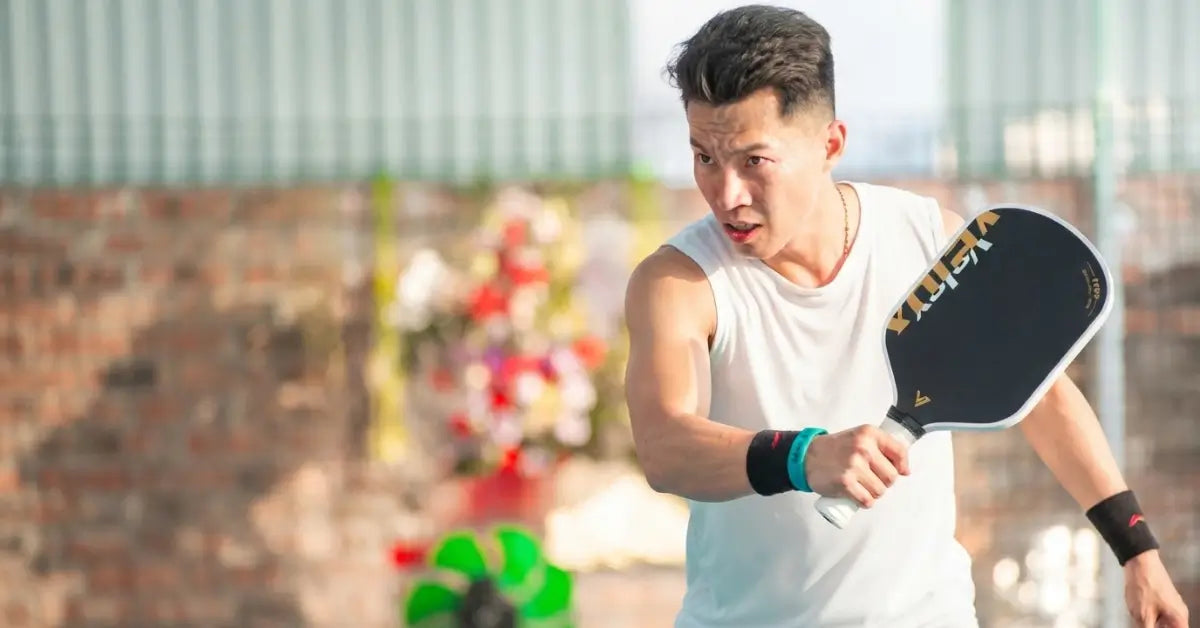
Your opponent drives the ball straight at your shoelaces from three feet away, and every instinct in your body wants to swing back just as hard.
You do, and the ball sails four feet long. That reflex is the whole problem with the pickleball reset — it asks you to do the opposite of what your nervous system wants in that instant.
It does work. It just isn't natural, and nobody explains why the instinct itself is the thing to fix.
Why Resets Feel Different From Every Other Soft Shot You've Learned
A dink is a shot you choose to hit softly. A third shot drop is a shot you set up from a standstill, with time to think. A reset is neither of those things — it's forced on you, usually while you're still moving, by a ball that's already traveling fast.
That's the part beginners miss. You're not generating touch from nothing, the way you would on a dink. You're absorbing pace that already exists and redirecting it, which is a completely different physical problem even though the paddle motion looks similar from the outside.
The panic reaction — tensing up and swinging back — makes sense biologically. It's just the wrong answer here.
A pickleball reset is a soft, controlled shot used to absorb the pace of a hard incoming ball and drop it into the opponent's kitchen instead of countering with power. It's typically hit from the transition zone or baseline while under attack, and it turns a defensive rally back into a neutral one.

The Split-Second Setup: Stopping Before You Even Touch the Ball
Movement is the enemy of a clean reset. If your feet are still traveling when the ball arrives, your paddle absorbs the ball's pace plus your own momentum, and that combination almost always pops the ball up.
Split-step the instant your opponent commits to their swing, not after the ball is already in the air. Land with a wide base, knees bent, paddle held out in front of your body rather than down at your side.
That extra half-second of stillness is the entire shot. Everything else is just finishing what the stop already set up.
Absorbing Pace Instead of Generating Touch
Here's the mechanical difference nobody names clearly: on a dink, your paddle adds a small amount of energy to a slow ball. On a reset, your paddle needs to remove energy from a fast one.
Think of it less like a swing and more like catching an egg — you don't stop your hand dead on contact, you let it give slightly backward while the paddle face stays open and angled up. Some coaches call this a "bunt" motion, and the label fits: short, quiet, almost no backswing at all.
Grip pressure matters even more here than on a standard dink, because a tight grip transfers the incoming ball's speed straight back out. Loosen your hold the moment you see the drive coming, not after it's already on your paddle.
Diagnosing Your Miss: Popup, Net, or Still Too Hard
Every failed reset breaks down into one of three patterns, and each one has a specific cause.
- Popup above net height: You were still moving at contact, or your paddle face was flat instead of open. Stop your feet first, tilt the face upward before the ball arrives.
- Into the net: Grip too tight, or the paddle face closed on contact from tensing up. Soften your hold and consciously keep the face open through the whole motion.
- Ball still comes out with pace: You're swinging instead of absorbing. Shorten the motion until there's almost no backswing left to remove.
Match your specific miss to the cause above before changing anything else. Most players guess at three fixes when only one actually applies to them.
If your resets keep showing up right after a shaky third shot, it's worth revisiting how to hit a consistent third shot drop, since a cleaner drop means fewer emergencies to reset out of in the first place.
Reset or Counter-Attack? Reading the Incoming Ball
Not every hard ball needs a reset. If it's rising toward your shoulder or higher when it reaches you, you have room to counter with your own aggressive shot instead of playing defense.
Anything arriving at knee height or lower, especially with pace, leaves you no real option to attack safely — that's a reset every time, no exceptions.
The gray area is everything in between, and when you're unsure, default to the reset. A conservative reset costs you a few feet of court position. A missed counter-attack usually costs the point outright.
This is the same math that governs the third shot itself — a cautious miss is recoverable, an aggressive miss rarely is — so if you're comfortable with that tradeoff elsewhere in your game, apply it here too.
Paddle Choice: Why Softer Paddles Make This Shot Easier
A stiff, power-oriented paddle face gives the incoming ball's energy nowhere to go except back out, which makes absorption harder to control under pressure. A paddle with more give in the face does some of the work for you.
Players sorting through Velox's paddle lineup built for newer players will notice the softer options all lean toward that same control-first face rather than raw power.
The Velox Diamond Pickleball Paddle is built specifically for spin and control, which is exactly the kind of forgiveness a player still learning to absorb pace instead of fighting it can use.
Doubles: Whoever Gets Attacked Resets, Not Whoever's Closer
The ball goes at your partner's feet, and your first instinct might be to poach across and take it yourself. Resist that. The player being attacked is the one in position to absorb the pace — cutting across usually means arriving late and off balance.
Call it early if you can. A quick "yours" the moment the drive is airborne beats a collision or a shared miss at the net.
This gets harder in mixed doubles when opponents deliberately target the weaker paddle. If that's you, don't wait for your partner to bail you out — own the reset and treat it as your shot to make, not a problem to hand off.
Staying Calm Is the Actual Skill
The mechanics of a pickleball reset aren't complicated once you separate them from the panic that triggers the need for one. Stop your feet, soften your grip, let the paddle absorb instead of fight, and the ball goes where you want it far more often than not.
Drill it on purpose, against real pace, until the calm version becomes the automatic one.
FAQ
What is a reset in pickleball?
It's a soft, controlled shot that absorbs the pace of a hard incoming ball and drops it into the opponent's kitchen instead of countering with power.
Is a reset the same as a dink?
No — a dink is a shot you choose to hit from a still position, while a reset is forced on you by a fast ball while you're often still moving.
Why does my reset keep popping up?
You're most likely still moving at contact or hitting with a flat paddle face — stop your feet first and keep the face open and angled up.
Should I reset or counter-attack a hard shot?
Counter only if the ball is rising toward shoulder height or above; anything at knee height or lower should be reset, no exceptions.
How do you get good at resets?
Drill them against real pace on purpose, not just in slow-motion feeds, since the panic reaction only fades with repeated exposure to actual speed.


