
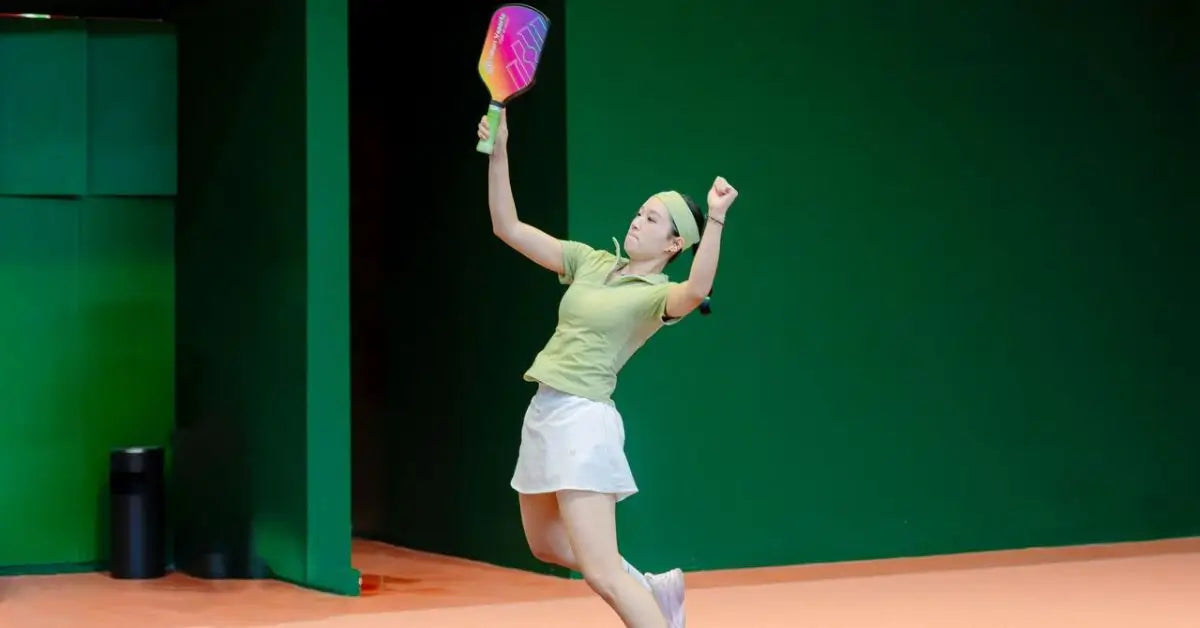
Your serve lands deep, the return comes back low, and now it's on you. You take one step forward, swing, and watch the ball die in the net — or sail three feet long and hand your opponents a free smash.
That's a pickleball third shot drop going wrong, and it happens to almost everyone somewhere between their tenth game and their two-hundredth.
The shot isn't complicated in theory. It's a soft, arcing ball that lands in the kitchen and buys your team time to reach the net. In practice, it's the hardest habit to build in this sport, and most players never get told exactly why theirs keeps missing.
What a Third Shot Drop Actually Has to Accomplish
Every pickleball rally follows the same opening sequence: serve, return, then the third shot. At that moment, the returning team is already standing at the kitchen line. You and your partner are still stuck twenty-two feet back at the baseline, and that gap is the entire problem the third shot has to solve.
Drive the ball with pace from back there and you're feeding it straight to opponents who are seven feet from the net with time to redirect it at your feet before you've taken two steps forward. That's the whole argument for dropping instead of driving, and at the recreational level it isn't really up for debate.
This shot doesn't win points on its own. It resets the court. Land it soft in the kitchen, and you've earned the right to walk forward.
A third shot drop is the shot the serving team hits on the third ball of a pickleball rally — a soft, arcing ball aimed at the opponent's kitchen instead of driven hard. It neutralizes the returning team's net advantage and gives the serving side time to move from the baseline up to the kitchen line.

The Body Position That Makes the Shot Repeatable
Most missed drops trace back to footwork, not hands. If you're lunging, falling backward, or stretching sideways to reach the ball, you've already lost the shot before your paddle touches it.
Set up behind the baseline with your knees bent and your weight forward on the balls of your feet, in a semi-open stance angled slightly toward the sideline. When the return comes, move your feet first and let contact happen out in front of your body, not beside your hip or behind it.
Players who came from tennis tend to take a big step and reach. Pickleball courts are short — twenty-two feet from baseline to net — so a compact adjustment beats a long lunge almost every time.
Grip Pressure and the Swing Path Most Players Get Backward
Here's the part almost nobody explains well: a third shot drop is a shoulder shot, not a wrist shot. If your wrist is doing any work at all, you've added a second hinge point to a motion that only needs one, and that's where inconsistency creeps in.
Hold the paddle loosely, somewhere around a three out of ten on a mental grip-pressure scale. A tight grip transfers more energy into the ball, which is exactly what you don't want on a shot built around touch instead of pace.
Keep the paddle face slightly open, brush low to high through contact, and let your shoulder — not your forearm — drive the motion.
Follow through toward your target instead of stopping the second you make contact. A short, punchy finish is usually what sends the ball into the net.
Paddle choice matters here more than most beginners assume. A forgiving sweet spot covers for the small mishits that come with learning touch, and Velox's Paddle Set of 2 is built around that kind of balanced, control-first design — a sensible pick if you're still smoothing out this shot.
Diagnosing Your Third Shot Drop Miss: Net, Long, or Popup
Every bad drop fails in one of three predictable ways, and each one points to a different fix.
- Into the net: Usually a grip that's too tight, or a paddle face closed at contact. Loosen your hold and open the face slightly before you swing.
- Sails long: Almost always too much wrist or too much backswing. Shorten the takeaway and let your shoulder finish the job instead of snapping through with your hand.
- Pops up above net height: Contact happening too far behind your body, or trying to lift the ball instead of brushing it. Move your feet sooner and meet the ball in front of you.
Match your miss to the list above before you change anything else about your technique. Guessing at a fix wastes weeks that a five-minute diagnosis could save.
Should You Drop or Drive? Reading the Return First
Recreational players are often told to drop every single third shot, no exceptions. That advice is outdated, even among pros, where driving the third shot has become far more common than it was just a few years back whenever the return sits up high and slow.
Read the ball before you decide. A return that lands short, low, and near your feet leaves you no choice — drop it, because you can't generate pace from that position without popping it up.
A return that sits high around net level, especially one with no spin, is drivable if you're confident hitting a flat, controlled groundstroke at your opponents' feet or the gap between them.
When in doubt, drop. A drop that lands short costs you a chance to advance. A drive that sails long or gets smashed back costs you the point outright.
Backhand Drops and Talking to Your Partner
Backhand Drop Mechanics
Opponents target the backhand on purpose, because it's the weaker side for most players. Treat your backhand drop like a smaller version of the forehand motion — same shoulder-driven swing, same low grip pressure, less hip rotation. Don't try to muscle it; a backhand drop trying too hard almost always sails long.
Calling the Shot With Your Partner
Two players hitting mixed signals on the third shot creates chaos at the net. Decide before the point whether you're both committed to dropping, or whether one of you will call "drive" out loud the instant a high return shows up. A quick verbal cue beats guessing every time.
A Drill Progression That Builds the Feel in Weeks, Not Months
Touch shots respond to repetition more than instruction. Try this sequence, three times a week:
- Hand-toss drops — stand at the baseline and toss the ball underhand into the kitchen, no paddle, to feel the arc you're chasing. Twenty reps.
- Self-feed drops — drop-feed yourself from the baseline and hit cross-court drops with a paddle. Aim for fifteen consecutive kitchen landings before you stop.
- Fed-return drops — have a partner feed you a return-speed ball so you're reacting instead of setting up. This is where the shot starts to feel like a real rally.
Give this two to three weeks before judging your progress. Players building this touch often work through the fundamentals of what a dink shot actually is around the same time — the soft-hands feel behind both shots is nearly identical.
The Shot Rewards Patience More Than Power
A consistent third shot drop won't show up in one practice session, and it won't come from watching one more video. It comes from diagnosing your actual miss, fixing the one cause behind it, and drilling the correction until it survives contact with a real opponent.
Get that part right, and the rest of your net game opens up behind it.
FAQ
What is a third shot drop in pickleball?
It's the soft, arcing shot the serving team hits on the third ball of a rally, aimed at the opponent's kitchen instead of driven hard.
Why do I keep popping up my third shot drop?
You're likely making contact too far behind your body — move your feet sooner and brush the ball in front of you instead of lifting it late.
Should beginners drop or drive on the third shot?
Beginners should default to dropping, since a drive requires pace and placement control that most new players haven't built yet.
How do you hit a backhand third shot drop?
Use the same shoulder-driven, low-grip-pressure motion as your forehand drop, just more compact, with less hip rotation.
How far back should I stand to hit a third shot drop?
Stay near the baseline until you've hit the shot — creeping forward before contact shortens your reaction time on anything hit back at you.
Is the third shot drop still important in 2026?
Yes — it remains the standard way to neutralize a net-side opponent, even as drives get used more often when the return sits up high.


